
Introduction
I would like to note that I had written out a longer, more detailed account of my previous week, which is probably hanging around a dark space on the internet somewhere, but it deleted itself after I pressed publish. Let’s hope that this isn’t a metaphor for my PGCE year! I am, unfortunately, now rewriting the post, but I have not included as much as I originally did, as I don’t have the time to go in to as much detail sadly.
Placement Begins
I am very fortunate to have been placed yet again in another amazing school. My Personal Tutor (PT), Associate Tutor (AT), the rest of the English department and any other member of staff I have come across have been eager to help me in anyway I can. I have already been asked if I want to observe more lessons than I have originally been put down for!
One interesting thing about the school that I will note, is that they have a Ready to Learn (RtL) behaviour management scheme. This is basically zero tolerance behaviour management, and is based on these three rules: Be Prepared, Be Polite and Work Hard. If a student breaks any of these rules, they have a warning and their name is written on the RtL section of the board. If they repeat the incident, or break another rule, they are then sent to the RtL room for a day. It seems a bit harsh, but I think it works well for this school –low level classroom disruptions have more or less disappeared since this was introduced last year. Along with this, I appreciate that the school already has firm behaviour management procedures in place, as this gives me scope to work more on the teaching itself initially, before thinking about the wider teaching experience.
First Teaching Experience
All English classes are mixed ability, and my timetable consists of years 7, 8, 9 and 11, as well as a year 8 tutor group. Initially, the plan was to teach a starter next week, but my AT suggested teaching a part of the lesson and I jumped at the chance to get my first time over and done with. Not that I thought it would be a negative experience at all – more so I can prove to myself that I do have the ability to do it.
The lesson I taught was the second part of a lesson on extended metaphors within Walt Whitman’s O Captain! My Captain!
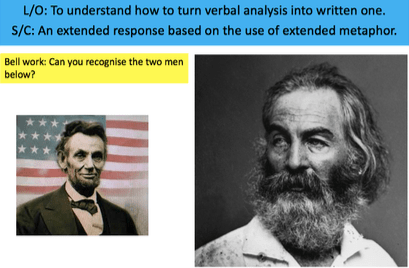
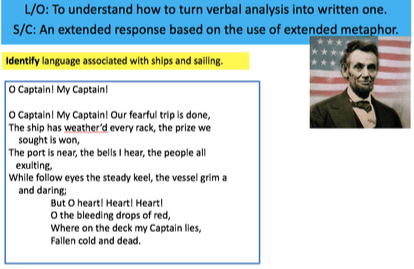
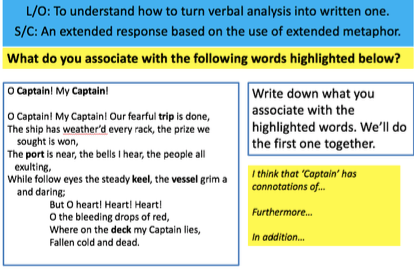
I’m not going to go into details about the lesson, but I will say that originally I was going to take the first two slides, but I ended up asking to teach a bit of the third slide as I was enjoying myself so much. I was amazed at how natural it felt being at the front of the class, and I am excited to give it another go next week. One thing I will note, is that I definitely need to ensure that I am comfortable with the plan before I start teaching, as I had a brain blank midway through the third slide and completely forgot what we had agreed to do! I surreptitiously handed the class back over to my AT but I am so proud of myself for getting further than I imagined I would in my first week.
Teachers as Writers
A lot of our conversation at university this week was about the role of teachers as writers. A lot of English teachers have graduated with Literature degrees, and will identify themselves as readers, but not necessarily writers. What I believe this all comes down to is that we should not expect our students to do things we are not comfortable in doing ourselves. One of the things that particularly pointed this out to me was a task we did on Monday, where we had to craft a piece of writing using the hand we wouldn’t normally write with:
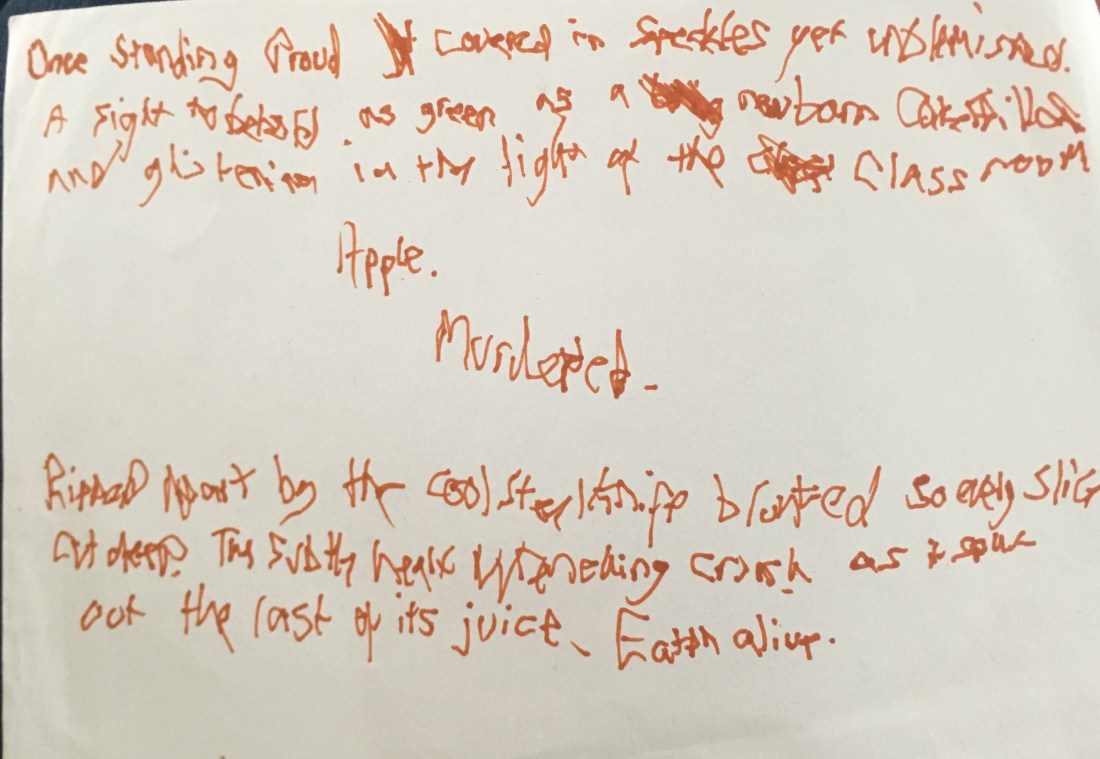
Once standing proud covered in speckles yet unblemished. A sight to behold as green as a new born caterpillar and glistening in the light of the classroom.
Apple.
Murdered.
Ripped apart by the cool steel knife blunted so every slice cut deep. The subtle heart wrenching crunch as it spat out the last of its juice. Eaten alive.
I mean it’s quite obvious to begin with that my handwriting is atrocious, and we discussed how appearances do not reflect the quality of work – but it’s easy to make judgements on how the writing looks. Also, most of us noted that as we were concentrating so hard on actually writing, most of the SPaG and content was not at as high a standard as it would be usually. This provoked interesting conversation in how our students may feel the same way, and what strategies we could use to help our students to find writing more enjoyable.
Mental Health Awareness
Mental health awareness day was this week, and I feel as if it is something that cannot go unmentioned, both on a personal and professional level. I have battled solitarily against my own mental health for well over a decade now, and I believe that over the years I have grown to accept that I suffer from anxiety in various forms (one of these being a rather attention-seeking shade of violent magenta that attacks my face when I feel uncomfortable or stressed). I have been happy enough to deal with this on my own, as my life is the only life it had been affecting dramatically, and I normally can talk myself out of uncomfortable situations.
However, I feel like now is a time for this to change. The last thing I want to happen is for my anxiety to get the better of me when I am teaching a class. It is not fair to have this affect my classes, and therefore I pledge to seek professional advise to see whether I am fine as I am, or if I should equip myself with a few tools to help keep a handle on my stress. Unfortunately, I know a fair few other people who suffer from worse mental health issues than myself, most of these due to traumatic incidents. These people, (and you know who you are if you read this!) deserve all the love in the world and should know that I will be there for them no matter what.
Professionally, I also pledge to look out for any signs of mental distress in my classroom. In one of the readings I did this week, Fleming and Stevens note that ‘The English teacher is in a highly privileged position – but this privilege carries its own burden of responsibility in terms of sensitivity’ (2015, 117), in talking about what we may come across within a student’s writing. I am so lucky to be in the position where I can encourage my students to write creatively, but this may result in conscious or subconscious disclosure within their work about. I feel that knowing exactly what to do in this situation (and we have all had enough safeguarding rammed down our throats) is the best way to appreciate the position we are in and ultimately be in such a privileged position where we can help the young people that need help the most.
Transferable Techniques
- Lesson menu – ensuring the students know exactly what will happen during the lesson, particularly useful for ASC learners
- ‘Chilli’ lesson objectives – ‘mild’ = All students will… ‘spicy’ = Most students will and ‘hot’ = some students will
- Learner of the lesson – picking an outstanding student to be learner of the lesson, and giving positive phone calls home.
Teaching Targets
I have decided to start making weekly reasonable, reflective targets that I shall reflect on each week in order to ensure that I am doing something new each week.
- Teach at least 2 more starters next week.
- Ensure I am confident in all aspects I will be teaching before I begin to teach.
J
Currently Reading:
As part of the PGCE, we have all been ask to read a recent young adult fiction novel to review. I chose Geraldine McCaughrean’s Where the World Ends, as it was the Carnegie medal winner this year. I have also included a few of the texts I have looked at this week in my placement, and due to this extra reading, I have not continued with Mrs Dalloway, The Tempest or the poetry anthologies I have been looking at. I expect I will resume this reading next week.
Where the World Ends – Geraldine McCaughrean
I have to admit, when I started this novel it felt a bit dry and was pretty hard to get into. Despite this, I perservered and I am 100% glad I did. I thoroughly enjoyed this book. Reminsicent of William Golding’sLord of the Flies in more than one way, yet based on a true story, the story follows a group of boys as they are seemingly abandoned on a tiny island as their return boat never came to get them. I won’t go into too much detail, but the ending was phenomenal – I would never have seen it coming in a million years which, to me, normally suggests that this was a book well worth reading.
O Captain! My Captain! – Walt Whitman
I had never come across this poem before going into a year 7 class Tuesday morning, but the more I read it the more I fall in love with it. In short, the poem is about the outcome of the American civil war and includes an extended metaphor where the USA is compared to a ship and Abraham Lincoln is implied to be the captain of the ship. It is exceedingly effective and is an absolute pleasure to read.
Shylock’s ‘To bait fish withal’ monologue – The Merchant of Venice – William Shakespeare
I am somewhat ashamed to say that I have never come across this monologue before in my literary career. Set to the usual Shakespearean standard of beautiful eloquence, Shylock talks about what it is to be equal and, despite the fact that his intentions are smothered with revenge, it is the epitome as to why prejudice is hatefu;
References
FLEMING, M. & D. STEVENS, 2015. English Teaching in the Secondary School” Linking Theory and Practice. Abingdon: Routledge.
 Much Ado About Teaching
Thank you for this very honest post. Mental health and wellbeing is so important both for you, and for your learners. Do let me know if there’s anything I can do to support you. You are the biggest resource in the lesson, so you need to see yourself as a priority. Well done on teaching your first lesson!
LikeLiked by 1 person