
Introduction
This week, I had an epiphany. This epiphany was that I can teach. I am a teacher.
No matter what happens next, with review point 2 and my PT observing me next week, I can sleep soundly knowing that when my students come into the lesson, they will leave it having learned something (the vast majority of the time!).
This epiphany has been a milestone in my PGCE career. I am no longer stressing about every little target and are looking at them as the stepping stones to make me the best teacher I can possibly be.
I want to be the best teacher I can possibly be.
So, with that in mind, I am as determined as ever to continue what I am doing, but to also let myself appreciate other things that are important in life. It was one of my friend’s birthdays this week, so I have allowed myself to have two evenings off (crazy I know) and dedicate my time to her. Yes, the work load is never ending. Yes, sometimes I feel like I’m drowning in things I need to get done. Yes, the stress that I am not working when I feel like I should be working 24/7 is never going to go away. BUT, I have been working on focusing on what I need to do to keep myself sane. Regardless of these epiphanies, I’ve been feeling more down than up this week and I can’t seem to pinpoint why. This next step in building my career is to make sure that it is manageable for me, and I don’t isolate myself in an infinite prison of work. I can be a good teacher and maintain good mental health – it’s just going to take a bit of time to work out how to harmonise the details.
Bottom set year 10, period 5, teaching tissue – so why the LOG?
Picture this….
‘Tissue’ by Imtiaz Dharker. Stunning, thought-provoking and inspirational, yet completely, utterly and astoundingly difficult to grasp. I have spoken to some teachers who still say they have no idea what Dharker was trying to achieve with this poem. Every English teacher I have spoken to has said this is, generally, the hardest poem to teach; the hardest poem for students to get their head around.
Tuesday, period 5. The end of the day, just had a break for lunch, concentration levels are low. The week is still new, there is more left of the week than done.
Year 10. Bottom set. Concentration levels aren’t best on the whole, throw something challenging in the mix and they don’t always appreciate it.
So why, why WHY did I decide to make this an officially observed lesson by my AT? He doesn’t know the class, but is obviously familiar with the lesson context, mentioned previously. (This was definitely a blessing in hindsight.) I was stressed beyond imagination about this lesson. One of my lovely colleagues said to me something along the lines of if you nail it, you’re a fantastic teacher. If you mess it up, you’re just like the rest of us – this made it feel more manageable but didn’t stop my nerves. Did I mention that I had already started Tissue the day before, it didn’t go overly that well and this is why it was moved to this lesson?
However, despite the over the top anxiety, the lesson couldn’t have gone better! (Actually, it definitely could have for reasons I will explain in due course… but in comparison to my expectations, it was the best it could’ve been!) The students were actually able to prove they understood (on a basic level) the poem and seemed to make progress in how they structure and write their ‘PEAL’ paragraphs (I mean we’ll see if they remember everything for the end of unit assessment, which will most likely be after half term!)
I also managed to tick off one of my targets – adapting the lesson as I go to meet the needs of pupils. I had a little… moment of human error. I may have been too prepared for the lesson, printing off the resources before checking them properly. I had typed up the paragraph we wrote together the lesson before, with the intention to have them underline where we would have met the assessment objectives. I then had another model paragraph ready, cut up so they could piece it back together. Turns out I had used the same paragraph for both activities, making the latter redundant… not my smartest move! However, I felt it was important to be completely honest with my students. They are all aware that I am a trainee teacher, and I feel that they empathise with me and – dare I say it – like me more because of my honesty with them. By treating them with the respect, on the whole, they have been completely respectful to me back. I like the idea that by showing them that I make mistakes, it makes it ok for them to make mistakes too – and that’s important.
After the lesson, I felt elated and relieved. However, the stress has come right back around again…. My PT is observing me with this class again on Tuesday. She is a deputy head, so hopefully they will behave… they definitely had ‘wind syndrome’ today, so I wouldn’t want a repeat of that!
Impostor syndrome strikes again
One of the things that I can’t seem to stop thinking about is how other teachers feel about my teaching. Every teacher seems to have their own personal list about what makes a good lesson, and they only seem to vaguely overlap with main ideas. This leads to me getting very varied feedback and can be completely confusing at times.
The one thing I find particularly hard to deal with, is when teacher’s interrupt my teaching to make a comment to the class. I know it is meant with the best intentions, and I am also completely aware that this is their class, and they are ultimately responsible for their progress – I am a complete risk in the eyes of education.
One moment that has particularly stuck with me this week, was when I was doing a preparation for the end of unit assessment. They were due to plan their assessment with their class teacher on Wednesday, as my PT meetings clash with that lesson, and she has taught travel writing many times before, and has a really clear idea about what she expects. Now, I knew that the students were going to write a piece of travel writing to entertain. We had looked at writing to inform and to persuade as well, and as a result used their ‘FASTER CARS’ acronym for what to include in persuasive writing.
I was taking general feedback about what makes good travel writing. I have been working on how to give students ownership over success criteria and, after spending a lot of time having to shut students down because it isn’t what I want them to come up with, I have found the easiest way to do this is to write down everyone’s answers and then come up with a final list. One of my higher ability students suggested FASTER CARS, and I added it to the board. In my head, I thought ‘great, a lovely little afl piece I can use later, asking them why we wouldn’t include this if we were writing to entertain’. Whilst I was writing this on the board, the class teacher addressed the class, completely shutting down the idea and explaining why that wasn’t going to be the case.
I know exactly why she did it, it just felt awful at the time. I felt completely undermined, more so because she didn’t give me a chance to see what I might’ve done with that information, or even catch my eye to see if it was ok to address the class. Moments like this throw my confidence and make me feel like just a trainee. I know it might sound silly because that is, in fact, what I am. But the majority of the time, as mentioned in my introduction, I do feel like a teacher. It’s just those moments that make me question my role in the classroom. Why am I doing this? Why am I humiliating myself?
Finishing travel writing….
On a slightly better note, I swiftly moved on from that moment and the students wrote their assessments on Thursday. They worked so hard! I have started marking them, based on the English Language Paper 1 Q5 mark scheme and grade boundaries and, so far, everyone has been on or above their target grade! It is such an amazing feeling!
… and starting 19thCentury Prose round 2
So, after finishing travel writing, which has definitely been my favourite SOW to teach, it was time to move on to 19thcentury prose. I recycled the introduction lesson, playing the Dickens’ game and research. It was a complete dream planning the second time round – I already had an idea of how to improve my planning, resources and teaching.
This was the sheet I used last time, for the research project:
They also had to find 10 more fascinating facts for homework and print out any pictures they want to use on their posters.
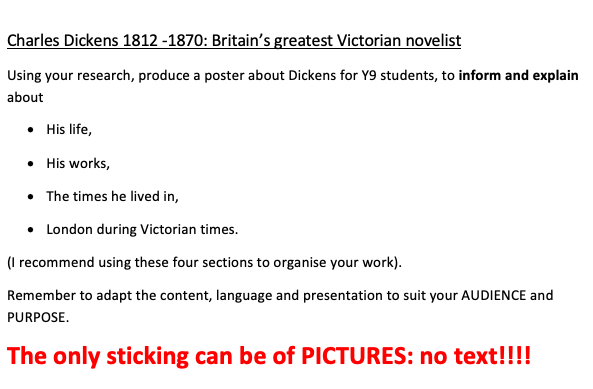
I found that some of this research was not directly relevant to the texts we study, and that it could be more useful to focus on gender and class, as opposed to London. Moreover, I had them take a page in their books and draw their own grid, with the intentions of having it filled in by the end of the lesson. I found that a lot of students spent nearly as long drawing and perfecting the grid than they did actually researching, and that a lot of them didn’t get at least 5 facts in each section – which was my minimum aim.
This is the new resource I created:
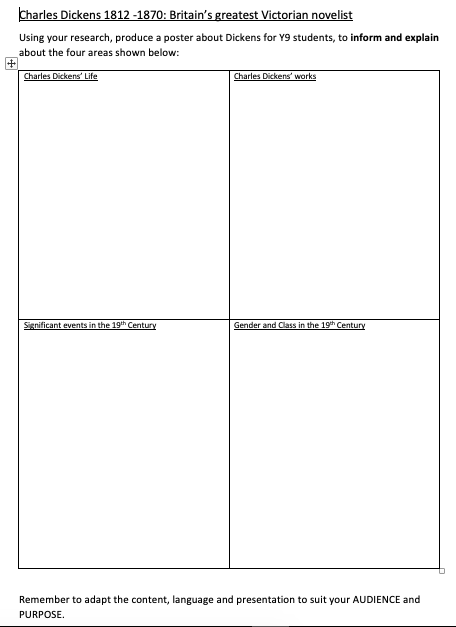
I figured that if they had a print out of the sheet, they would be able to take it home to finish off for homework (a fantastic motivating factor!). I also added to this homework, by telling them to find 5 fascinating facts about Bleak House. I am hoping that this will help them to have an idea about what the mammoth novel is about, before approaching it with them next week.
My hard work paid off – this was definitely an easier way to do the research! I also asked them to pair up and split the research, as we didn’t have as much time as I would’ve liked (Friday timings are slightly shorter and I was in a year 10 assembly that ran on for an extra 5 minutes = 10 minutes of lesson time gone… plus we had to actually get to the computer room!). The majority got at least 15 points down, and they worked well together to finish off their research… although they will be dismayed when they see I have put them in different groups on Monday!
J
Currently Reading:
The Eolian Harp & Kubla Khan – Samuel Taylor Coleridge
Kubla Khan is now one of my favourite poems. It is a unique poem, interweaving the ‘sublime’ with the exotic, creating a beautiful Romantic masterpiece.
Bleak House – Charles Dickens
Animal Farm – George Orwell
A Monster Calls –Patrick Ness
More than one tear was shed in the reading of this book – cancer being an illness very close to my heart. I loved reading about a boy struggling with accepting his Mum’s inevitable death. A very accessible book, an easy read but a sensitive topic… may not be suitable for all students!
 Much Ado About Teaching