
Introduction
Ok, so the past few weekends I have been super busy, resulting in shorter than intended blog posts. I spend the weeks mind-mapping in my head what I will write about (normally in the car on the way home from school!), promising myself I’ll make a start midweek, so I don’t have to do it all on Friday or Saturday. Yeah, that never happens! So now I’m going to rack my brains and pick out the salient parts of the past few weeks, so some may overlap with other blog posts.
Also, as it is now May half-term, I figured I may as well join these two weeks together – as my half term will consist of family, assignment, marking and a trip to Germany! Not the makings of a particularly interesting work-related post!
Pupil Progress
The first thing I wanted to bring up was the progress of one of my students in particular. He is in my bottom set year 10 class and has got a phenomenal attitude to learning. He listens carefully, joins in with class discussions and seems to have a good grasp on the general knowledge needed for English Literature paper 2. However, back in February, he was consistently struggling to regurgitate his ideas into essay format.
One example of this is from his assessment on unseen poetry, taken at the beginning of February:
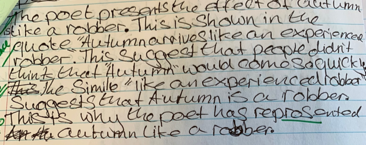
The poet presents the effect of autumn is like a robber. This is shown in the quote “Autumn arrives like an experienced robber”. This suggest that people didn’t think that “Autumn” would come so quickly. The Simile “like an experienced robber” suggests that Autumn is a robber. This is why the poet has represented autumn like a robber.
As you can see, his response is very limited, simple and repetitive. He understands what he needs to put in his ‘PEAL’ paragraphs, but is actually struggling to show an understanding, and is limiting himself to a lower level. He had two more paragraphs similar to that, placing him at a grade 3. His assessment on power and conflict poetry was much the same.
Part of me loves his end sentence – he puts a sentence like that at the end of every paragraph he writes. I’ve told him that he doesn’t get any extra marks for writing it, and that the ‘link’ part is more about writing cohesively or comparing in a comparison question. I can’t remember exactly what he said, but he basically told me that he wasn’t going to stop doing it! (One step at a time I guess!!)
Fast forward a few months, and I am taking them to revise unseen poetry again before their exam after half term. In the first lesson, I walked them through how to approach an unseen question and then they wrote a couple of paragraphs, which I informally assessed.
This is what he produced:
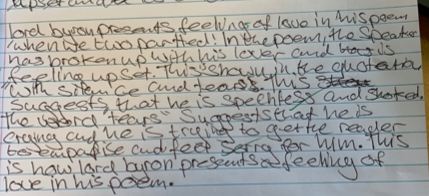
lord byron presents feelings of love in his poem ‘when we two parted’. In the poem, the speaker has broken up with his lover and is feeling upset. This is shown in the quotation “with silence and tears”. This suggests that he is speechless and shoked (shocked). The word “tears” suggests that he is crying and is trying to get the reader to empathise and feel sorry for him. This is how lord Byron presents a feeling of love in his poem.
I feel like you don’t have to be an English teacher to instantly see an improvement in his work. His response is far more focused and shows a good understanding of the poem. He explores his chosen quotation in a lot more detail and, whilst he doesn’t use any subject terminology, he is addressing AO2 in a much more meaningful way.
Obviously, I am not alone in helping him achieve this. Their class teacher is astounding, and I have learned so much from her in a short time. However, this is the first time I have seen one of my students make such a noticeable improvement – and I am so completely and utterly proud of him! I made sure to use that paragraph as an example in our following DIRT lessons, giving him a bonus two house points as well!
Year 9 Exams
My lessons in year 9 this week weren’t overly exciting, as they were completing AQA English Language Paper 2, as part of year 9 exams week. I set them revision over the weekend, and they came in less than motivated on Monday! However, they made it through, earning a revision lesson at the end of the week. A few of the other teachers had finished the exams and had booked out computer rooms so that the students could revise for some of their other exams. My at told me that that’s what he would be doing, so advised me to do the same!
Obviously, in this situation, behaviour management changes a bit. As usual, I could’ve been a bit stricter and made sure they were all revising the whole time. But I felt empathetic towards them – they are only in year 9 and being made to do exam after exam all in one week! Even the year 11s have it spread out a bit more!! I took this as a lesson I could build my relationships up with the class even more.
I have marked the reading section of the exam and, not going to lie, marking a whole exam paper is a lot more taxing than I imagined! The mark scheme is very vague, and I have to bear in mind that these are year 9 students being marked against a year 11 mark scheme – something I will be reminding them of when I hand them back!
Timing seemed to be the biggest issue for most of them, which is great to have as a target in the step up into GCSEs. Nevertheless, there is a whole lot of potential in these students. Some of my HAPs have done extraordinarily well, and I have been ultra-picky so that they don’t feel like they have nothing to do in the coming years!
10X5
My Animal Farm revision card lesson went down well – which was great as I had a fellow PGCE student observing me. She didn’t come on the most interesting day (I wasn’t teaching my year 12 class and the year 9s had an exam!), so having the bottom set year 10 class ready for period 5 on a Tuesday was definitely going to be interesting!
As the revision cards went down well for the power and conflict poetry, I figured it was a no brainer to do them for Animal Farm too. Again, I said they could sit where they wanted, because they worked so well in the previous revision class lesson. (Weirdly, they all decided to cram together on the opposite side of the classroom to my friend – they proper make me laugh sometimes!) This time I gave them a smaller, achievable target of 6 completed revision cards, as opposed to the full 15, making sure they covered all three assessment objectives. Again, I differentiated down for my less cooperative students – but one of them showed way more initiative than he had done in the previous lesson, coming up with his own ideas, as opposed to the more heavily scaffolded cards for the other three students. Some people may have though I should be stricter with them, however, I knew that giving them a ‘C1’ or ‘C2’ behaviour point, they would not do any of the work – especially as it was period 5!
I finished the lesson off with a quotation challenge, where they got into groups to remember as many quotations as they possibly could. They then wrote them up on the board in a time limit, gaining 2 points for every unique quotation they remembered. I named my two higher attaining students the captains and let them choose their own groups. (Side note – this led to unfair groupings and a few students not putting in much effort to this task) They really loved doing this and showed themselves how much they actually know about Animal Farm.
I had decided with the class teacher to do a general revision lesson on my last day with them before half term, as this would be the last lesson, they will all be together before their mocks begin. The first half of the lesson went well – we mind mapped different revision techniques (I used one of the students to scribe for me on the board – she loved it and it allowed me more freedom to tactically position myself in the room for BfL!). I then gave them 2 post it notes – asking them to put a smiley face on one, a sad face on the other, making sure their name was also on it, then getting them to put it on the board next to the topic they felt most or least confident in. This was very useful for me to see visually where I could direct support to. My original plan was to see if I could partner up students to teach each other, but I realised that would result in me having to sort out groupings on the spot, thinking about both who would work well together and the balance of who feels confident in what. So I scrapped that, and decided to do a more general approach to revision.
Boy do I regret that decision! In talking them through the different aspects of the exams and getting them in turn to tell me what they knew they had to do, it resulted in a really boring end to the lesson. In hindsight, I could’ve set them a task to do whilst I quickly sorted out groups and mini-tasks to do – it wouldn’t have taken too long to sort out (there’s only 12 of them!).
Back in year 12
It was so lovely to get back in front of the year 12 lit class on Thursday. I am super excited to be setting their homework task for over the half term – to create revision videos for Coleridge’s poetry! I came up with the idea after watching the dubious clips of Lime Tree & Rime and, back in P3, the students excitedly expressed their interest in undertaking such a project. Unfortunately, there wasn’t enough class time to devote to it, so they have been asked to complete it for homework and we will be screening them on my last lesson with them, which is actually my last ever lesson at Kings!
So the first half of the lesson revolved around getting that organised, sorting out groups and discussing ideas to get started. The latter half of the lesson was on Christabel. Originally, I was going to take the whole lesson to set the homework task, so they could start planning it together, but their teacher hadn’t quite finished the anthology yet, due to their exams, and she was keen to get them finished before half term – Christabel being the last one. However, it being such a long poem, it required two lessons on it so that meant I had to make some last-minute changes to my lesson the night before!
Annoyingly, as a result of this, I do not think I taught to the best of my standard – mainly because I had to rush to remind myself of the poem, meaning the stretch and challenge element of my lesson was basically not there. Also, I had forgotten that they had changed to Friday timings, due to there being Ascension Day services, meaning I had less time than I anticipated, and I did not manage to do the plenary task I had planned. I got all the students to write their findings on the board – which took longer than anticipated too. In the end, they had just about enough time to finish writing their findings up – one student offered to take a picture of it and send to the group chat, so they could finish filling in their tables. Their answers were good – again, I did not feel as if I had enough subject knowledge myself to be able to add in extras – but also there was not enough room on their sheets to write in more than one point!
Nevertheless, my worries disappeared when a few of my students told me, later on in the day, about how much they really enjoyed my lessons… I must be doing something right!
Middle School
The year 7s were doing drama… and it was crazy! Their teacher told me to bear in mind that KS3 drama will end up with you doing more crowd controlling than teaching… but they had the best time! We started off with splat (love that game… but proved hard when I didn’t know many names!) and then a few warm up exercises, where they had to work as a team to create certain things.
Ground rules seemed to be key for drama – the first group went completely crazy, all the boys wanted to just fight each other, and the girls were spinning each other round. In the next session, the teacher made it completely explicitly clear that that should not happen! I guess, it being fairly different to English, the main thing is to expect the unexpected and not to be too strict – it’s not their fault they get so excited!
The year 8s were doing their presentations. They had to create their own charity, to do with homelessness, and then had to persuade us to give our ‘money’ to them in a presentation. It was all done for homework, and they were allowed to work in small groups or individually.
Instead of getting them all to present to each other, they were split into tables of 3 or 4 groups, each getting a scorecard. They rated each other on the persuasiveness of the presentation and how unique their charity was, before tallying up the results and getting a winner from each table to present to the group. This way seemed so much less tedious than getting each group up to present in front of everyone. It also reduced the anxiety that comes alongside presenting in front of their peers.
Observations in other subjects
Having a reduced timetable has allowed me to spend time observing other lessons. I have been focusing on low attaining year 10 students, looking at differentiation and behaviour for learning. The main thing I noticed was that behaviour for learning had to come first. Quite often, there were a few disruptive students that would lead to the majority of students being off task. One teacher was flexible with his seating plans, ensuring that if there were issues, he would switch them around, another had a teaching assistant in there, who was asked to shut down any students off task whilst she dealt with another student outside and another teacher had a laminated A3 poster at the front of his classroom, using to explicitly and visually praise students for meeting certain rules of his classroom.
I also couldn’t resist observing a-level sociology. I have taught about half the class and thought it would be interesting to see them in a different dynamic. Neither classes had seating plans, so it surprised me to see the students not sitting next to the people they would in English! As there is only one teacher and one class for year 12 sociology, the teacher told me she preferred to create workbooks for them to work through each lesson.
Dystopian Fiction Club
I am so sad I am only going to have one more session with these year 9s! We compared the opening of the hunger games novel to the opening of the movie, and they had so much to say about it. It is so refreshing to see such passion in young, avid readers. Makes me glad they’re here for the books, not just the free biscuits!
J
Currently Reading:
Half-Caste and Other Poems– John Agard
Interestingly, I read his poem ‘crybaby prime minister’ the morning before I saw Theresa May’s speech this week… a very weird coincidence!
The Woman with the Red Hair– Clive Tuckett
My Dad recommended me this one, as he works with the author! Only read the first couple of chapters but looking like something that is right up my street – love a crime novel!
Bleak House – Charles Dickens
You may be shocked to read this… but I’ve actually finished it! I made the most of my time on the plane to and from Germany to get through the last quarter of the novel. I have to say, I already knew what was going to happen – which was definitely a shame! But I have really enjoyed ploughing my way through this one… I’m just going to dedicate longer novels to the summer from now on, when I actually have the free time to read them!!!
Stone Cold – Robert Swindells
I actually finished this novel last week but ran out of time to talk about it. It is the class novel the year 8s are reading… and I read it in about an hour! It uses a dual narrative – one side told by a young runaway, who has become homeless, and the other by a veteran who hates the homeless and has started thinking up his revenge on them. It is a very cleverly told story and perfectly teaches the young readers why we should empathise with the homeless. Lots of great conversations ensued!
 Much Ado About Teaching