Term 1… Blink and You’ll Miss it! [Part Two]

Now I finally know all my students (bar the few that have never turned up to my lessons), life is so much easier. There is so much power in learning a name – particularly when there is a ready to learn behaviour system!

7C – Tutor

Firstly, I thought I would update you on my lovely tutor group. Unfortunately, I have had to have a lot of chats about kindness with them. The transition to secondary proved hard for a lot of them, especially the ones who struggled in primary. I have decided to make this a priority in the next term, where I will have a focus on emotional literacy. Other than that, they have been a complete delight! My head of department (also my NQT mentor) has very kindly offered to take the tutor group on a Friday, giving me a chance to catch up with various different tasks. Even though it’s only 15 minutes in the morning and 10 minutes in the afternoon… it does make a big difference to my day!

7A3 – Introduction to Poetry

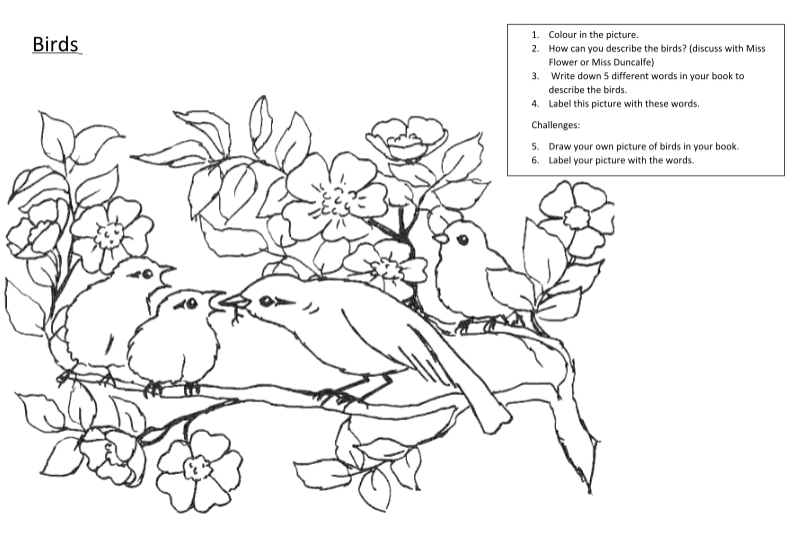
Differentiation has been the biggest challenge with this group. I have got two lovely students with a reading age of around 5 – they only got 2/20 on a KS1 reading test. They have a teaching assistant with them and I had made them various worksheets to do instead of the main lesson. However, they still found these sheets inaccessible. I had a think and a chat to their TA to come up with something that they could access, that would promote the use of different words and could potentially build up their vocabulary. As seen in the picture below, this is the kind of sheet I do for them in each lesson now. The picture is loosely related to whatever we are studying (for example, the birds are for Hope is a Thing with Feathers) and then they have to complete the tasks.

So far, this seems to work really well. The colouring really helps them to settle and the repetitiveness of these activities mean they know exactly what they are doing in my lessons. I am also able to give them praise points if they go above and beyond what I expect of them, which is completely fantastic!

One of my highlights of this group this term has been the relationship I have built up with one particular student. At the beginning of term he didn’t contribute much and, in his notes from primary, it said that he was very shy. I will never forget we had on O’ Captain, My Captain’ where I witnessed a confidence shift in front of my eyes. He has a ridiculously detailed knowledge about American presidents (he knows more than me!!) so I referred to him as the class expert throughout that lesson. At the end of the lesson, he stayed behind to thank me. He said he has never felt that confident in a lesson before. Since that lesson, I have watched him blossom into the kind of student who will answer any question I throw at him. He has also showed me some poetry he had written in his spare time. I made sure to ring home to tell his parents about how fantastically he is doing this term, and his father sounded like he was crying with joy! Honestly, I can’t get over how amazing this job can be.

8A2 and 8C – Ballads

I see 8A2 a bit more than 8C they work harder and stay on task more so they are an easier group to manage – they are also a much smaller group which helps! On the other hand, 8C are an extremely lively class, but we have had some incredibly interesting debates about the various topics that come up. I do not do the spacing tasks with 8C, which is a shame because they love creative writing.

I have found that with both groups, but especially 8C, the lessons we have in period 5 are extremely challenging. I have tried a few different strategies with both groups – 8A2 respond well to having a 15 minute quiet task to start off with, before moving on to the main lesson, but 8C would still remain off task for the majority of the lesson. Then only thing I have found that works with them, is watching a video and then doing creative writing based on it. (An example being watching a video on the jobs children had in the industrial revolution, then writing a diary entry about a day that went wrong at work).

Whilst this has been great, because anytime I tried to do a normal lesson, I would end up having to redo it the next lesson anyway, I am concerned that I am not following the scheme properly, and we have missed out a few bits. At this point, however, the students seem to be enjoying English and I had my first period 5 lesson with 8C in week 8 where I did not want to cry from exhaustion at the end of it!

10F1 – Macbeth

I LOVE TEACHING MACBETH. There, I said it. I did not think I would enjoy teaching GCSE English literature in a year – it is a lot of work, but so far I am thoroughly enjoying it and, I am ecstatic to say, we have finished reading the play! We’ve got a week and a half left on the play, and I have left out a few important scenes I want to go back over before their end of unit assessment, but I am feeling, on the whole, confident with these students. I have got such a delightful class – I always look forward to teaching them!

11S – English Language Paper One

Year 11s have proven to be my most challenging group. Their behaviour is technically good, they follow all the school rules and get the work done well. However, they just don’t engage with me or each other! It is actually painful at times. I’ve only had three hands up over the term, to answer a question I have asked, and two of them were from the same person! Hands down questioning has definitely been my best friend in this class.

Luckily, the HLTA in our department has been allocated to this class in a week 1, so I am not alone in my misery! Don’t get me wrong, they’re a lovely bunch, I just find myself getting bored or doing a LOT of teacher talk. They have their mocks on the first day back, so we will see how they go before I comment further!

Currently reading

Knife Edge – Malorie Blackman (currently on hold as I’ve lent it to a student over half term – I knew she would read it quicker than me!)

Tales of Mystery and Imagination – Edgar Allen Poe

Wise Children – Angela Carter

Othello – William Shakespeare

Week 27: Kindness

Introduction

Kindness. It goes a long way. I have grown up smothered in it and I know first-hand what a difference it can make. I am a massive advocate for bringing a tiny ray of sunshine into someone’s gloomy day; just one moment of brightness has the potential to change someone’s life around.

I learned this from my paternal grandparents. Like myself, they were secondary teachers, as well as being Methodist missionaries. Their lives revolved around making the world a better place, bringing this light into people’s lives and consistently putting other people first. They were retired by the time I came into their lives, but I can imagine the sort of teachers they were. On my bad days I think of them, I think of the difference they must have made in hundreds of thousands of students’ lives between them and I know that this is in my blood. I want to be like them.

This week has been a great week for me. Because I have been putting other people first, putting kindness first. There are a few people (both friends and students!) in my life that are going through a tough time (understatement – you know who you are!) and it completely breaks my heart. However, in putting these other people first and giving up a bit of my ‘busy’ schedule to show how much I care for and about them, and doing my best to make a difference in their lives, no matter how small, I have found that I have become quicker at lesson planning – particular now I am planning in reverse and keeping it more focused around lesson objectives and outcomes.

I am so happy to say (and with two weeks left of placement 3 I’m hoping it stays this way!) that I am feeling the best I have felt in years both mentally and emotionally. I am genuinely proud of myself and the progress I have made – doing it the Duncalfe way!

So, if this is as far as you read (and I won’t blame you if this is the case… I’m clearly in a rambly mood!), make sure you sprinkle a bit of kindness in your day – it can really make a difference to both your life and the people around you. This is something we all need to remember – especially with the news about New Zealand this morning. My heart still belongs in that country, and it is broken to hear that such devastation has hit Christchurch again. 

Anyway, now that’s off my chest, I will go through my week as usual!

Cutest moment with a year 9 student!

Its moments like this that make everything worth it. One of my lovely year 9s mentioned last week that she had read ‘Red Queen’ by Victoria Aveyard, and she said she enjoyed it just as much as the Hunger Games… I was sold!! I just mentioned in passing that I’d add it to my ‘books to read’ list and she said she would let me borrow it. I didn’t think anything of it and, honestly, totally forgot about it!

Tuesday’s lesson came around, and this student hung around after the rest of the class had gone. She rummaged around in her bag for a bit, I asked her if she was ok and then she pulled the novel out of her bag with a shy smile on her face. My heart melted. She was so excited for me to read it. She even said to me “Don’t rush it. I know you’re really busy and reading lots of other books too!” 

MY HEART COULD BURST. This is one of the sweetest things anyone has done for me – let alone a student. I will remember this moment for the rest of my life. 

9Y3 First drafts

I was extremely proud of my 9Y3 class this week! As (I think) I have mentioned before, I decided to take more of a coursework-y approach to the travel writing unit with 9Y3. When I did this unit of work with my other year 9 groups last term, it couldn’t have gone better and nearly all of them met or surpassed their target grade. So, after speaking with my AT, I decided to try something completely different – and I figured I may not have a chance to do this kind of drafting and redrafting when I have my own classes (hopefully!) next year. 

This idea of coursework was lost on the majority of the class – they are reluctant to edit their own work, often struggling to pin point what they have done well, let alone what they could improve!! However, I believe they have come around to the idea – particularly after saying they may jump up one or even two grades after editing their work!

The majority of them finished their first drafts on Thursday, and there were even a few keen beans who wanted to do more at home! I started marking them today… and I have to say… the progress made from the last paragraph I marked (just over a week ago) is phenomenal already! I am very excited to see what they will be producing!

10X5 absolutely crushing Animal Farm!

It’s clearly the week of feeling proud of my students this week. My bottom set year 10 classes are showing a fantastic understanding of Animal Farm. I have taken to do ‘team challenge’ plenaries (they love a bit of competition) and they have been flourishing. Some of them have even started quoting from the text already! 

Language A-level

I’ve sandwiched this part in with the good parts of the week, hiding the not so good amongst the great to lessen the blow. I mean, it’s not that bad, but it is definitely more than the recurring little niggling thought it started out as.

So, my university tutor is coming to observe me with my 12 language class. This is totally fine. Totally fine, except I still haven’t taken them for a whole lesson. Totally fine, except not all of these students want to be here (thanks to the ‘you must stay in education until your 18 rule’). Totally fine, except I am 110% terrified.

Now, it may not seem like a big deal. On the whole, they are a well-behaved class and I have really enjoyed teaching them when I have team taught a lesson. However, the amount I am required to know suddenly shoots up. I have always loved English language – I definitely would not have graduated with the grade I did if I did not do language. So why then…. Why why why does my brain decided to regularly fail me. I KNOW WHAT THESE TERMS MEAN. Why do they disappear from my head when I need them to be fresh. 

I guess it is partly because my priorities lie with the year 9s and 10s. I see them (pretty much) for all their lessons, whereas I only see each a-level class around twice a week. Therefore, I often find it lower down on my priority list. 

But anyway, I’ve spoken to the class teacher I share the class with. We have a plan in place. It’s just a waiting game now. I’ll take the whole lesson with them – for the first time – next week. So, I’m just praying that it goes well and gives me a confidence boost!

Rime of the Ancient Mariner – Feminism, Marxism and Psychoanalysis!!!!

Contrasting my previous point, I have found that I am loving teaching a-level English literature – and I was completely sure that I would not enjoy Coleridge one bit! 

This week I took my two lessons to go through the mammoth ‘Rime of the Ancient Mariner’; I quite enjoy the poem myself and (after reading York notes along side it) found it relatively easy to understand – particularly in comparison to some of his other poems! As my feedback was to use a range of different activities with the 6thformers, I made sure I meticulously planned a range of different activities with them. 

I was then told 5 out of 10 would be on a school trip! Slightly annoying, but not the end of the world!

I decided to keep my plan similar (I won’t go into the details – just included group work then creative consolidation), however, I ended up completely changing this as 4 out of the 5 students weren’t sure about the poem (I’ll bet a couple didn’t even attempt reading it!). I ended up literally talking through the poem with the students – and it felt fantastic. They went from not having a clue to coming up with remarkable suggestions that I hadn’t thought of in the space of just under an hour. It was a lesson where I could see definite progress had been made, and the students were very thankful for me to have helped them out with it!

The following lesson I had them on my own for the first time and, annoyingly, the lesson went perfectly! Exactly as I wanted it to go! Obviously there are still many things I need to improve on, especially stretching and challenging, but, by the end of the lesson, the students had adopted different critical points of view (feminist, Marxist and psychoanalysis) and used them to talk through ideas and themes in the poems, then seamlessly linking it altogether with An Ideal Husband.  I don’t see them next week, but in my last week I will definitely make it my aim to ensure I am including way more challenging moments to ensure I have covered enough for the students to get the top grades!

#reimaginediary

Finally, I wanted to end by talking about the reimagine diary project I started last weekend. I have loved keeping a daily diary – especially as I have been using Mayfly Sound(click to go to their website!). Now, don’t get me wrong, I love writing! But it is ridiculously time consuming. With Mayfly, you capture your voice recording and link it to different pictures of mayflies – so you can listen back to the recording when you scan the picture. Very simple, but very effective; saves a lot of time too! I love it!

J

Currently Reading:

Rime of the Ancient Mariner – Samuel Taylor Coleridge

Red Queen  – Victoria Aveyard

Animal Farm – George Orwell

Week 22 – The Epiphany

Introduction

This week, I had an epiphany. This epiphany was that I can teach. I am a teacher. 

No matter what happens next, with review point 2 and my PT observing me next week, I can sleep soundly knowing that when my students come into the lesson, they will leave it having learned something (the vast majority of the time!).

This epiphany has been a milestone in my PGCE career. I am no longer stressing about every little target and are looking at them as the stepping stones to make me the best teacher I can possibly be.

I want to be the best teacher I can possibly be. 

So, with that in mind, I am as determined as ever to continue what I am doing, but to also let myself appreciate other things that are important in life. It was one of my friend’s birthdays this week, so I have allowed myself to have two evenings off (crazy I know) and dedicate my time to her. Yes, the work load is never ending. Yes, sometimes I feel like I’m drowning in things I need to get done. Yes, the stress that I am not working when I feel like I should be working 24/7 is never going to go away. BUT, I have been working on focusing on what I need to do to keep myself sane. Regardless of these epiphanies, I’ve been feeling more down than up this week and I can’t seem to pinpoint why. This next step in building my career is to make sure that it is manageable for me, and I don’t isolate myself in an infinite prison of work. I can be a good teacher and maintain good mental health – it’s just going to take a bit of time to work out how to harmonise the details.

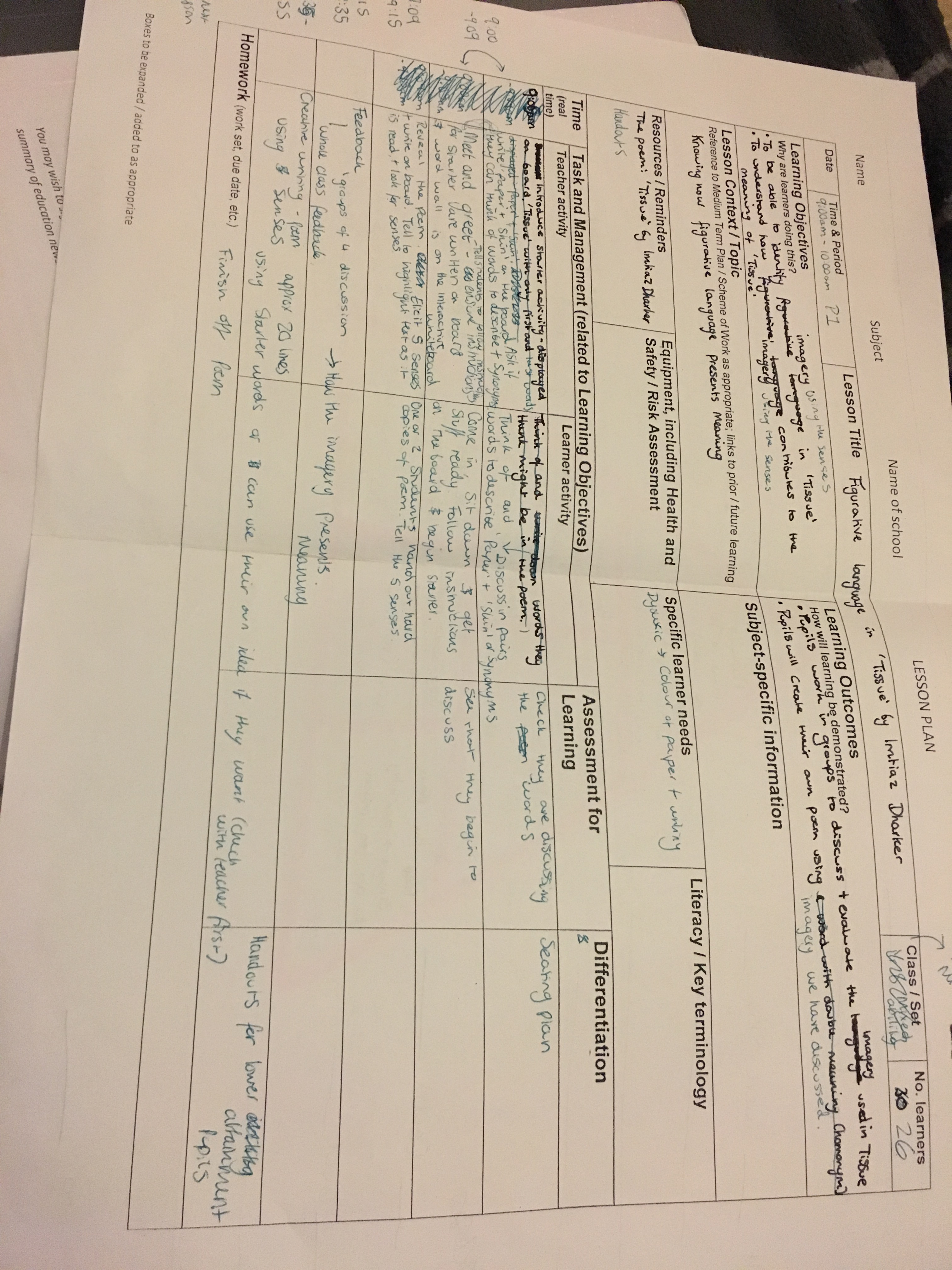
Bottom set year 10, period 5, teaching tissue – so why the LOG?

Picture this….

‘Tissue’ by Imtiaz Dharker. Stunning, thought-provoking and inspirational, yet completely, utterly and astoundingly difficult to grasp. I have spoken to some teachers who still say they have no idea what Dharker was trying to achieve with this poem. Every English teacher I have spoken to has said this is, generally, the hardest poem to teach; the hardest poem for students to get their head around.

Tuesday, period 5. The end of the day, just had a break for lunch, concentration levels are low. The week is still new, there is more left of the week than done. 

Year 10. Bottom set. Concentration levels aren’t best on the whole, throw something challenging in the mix and they don’t always appreciate it. 

So why, why WHY did I decide to make this an officially observed lesson by my AT? He doesn’t know the class, but is obviously familiar with the lesson context, mentioned previously. (This was definitely a blessing in hindsight.) I was stressed beyond imagination about this lesson. One of my lovely colleagues said to me something along the lines of if you nail it, you’re a fantastic teacher. If you mess it up, you’re just like the rest of us – this made it feel more manageable but didn’t stop my nerves. Did I mention that I had already started Tissue the day before, it didn’t go overly that well and this is why it was moved to this lesson?

However, despite the over the top anxiety, the lesson couldn’t have gone better! (Actually, it definitely could have for reasons I will explain in due course… but in comparison to my expectations, it was the best it could’ve been!) The students were actually able to prove they understood (on a basic level) the poem and seemed to make progress in how they structure and write their ‘PEAL’ paragraphs (I mean we’ll see if they remember everything for the end of unit assessment, which will most likely be after half term!) 

I also managed to tick off one of my targets – adapting the lesson as I go to meet the needs of pupils. I had a little… moment of human error. I may have been too prepared for the lesson, printing off the resources before checking them properly. I had typed up the paragraph we wrote together the lesson before, with the intention to have them underline where we would have met the assessment objectives. I then had another model paragraph ready, cut up so they could piece it back together. Turns out I had used the same paragraph for both activities, making the latter redundant… not my smartest move! However, I felt it was important to be completely honest with my students. They are all aware that I am a trainee teacher, and I feel that they empathise with me and – dare I say it – like me more because of my honesty with them. By treating them with the respect, on the whole, they have been completely respectful to me back. I like the idea that by showing them that I make mistakes, it makes it ok for them to make mistakes too – and that’s important.

After the lesson, I felt elated and relieved. However, the stress has come right back around again…. My PT is observing me with this class again on Tuesday. She is a deputy head, so hopefully they will behave… they definitely had ‘wind syndrome’ today, so I wouldn’t want a repeat of that!

Impostor syndrome strikes again

One of the things that I can’t seem to stop thinking about is how other teachers feel about my teaching. Every teacher seems to have their own personal list about what makes a good lesson, and they only seem to vaguely overlap with main ideas. This leads to me getting very varied feedback and can be completely confusing at times. 

The one thing I find particularly hard to deal with, is when teacher’s interrupt my teaching to make a comment to the class. I know it is meant with the best intentions, and I am also completely aware that this is their class, and they are ultimately responsible for their progress – I am a complete risk in the eyes of education. 

One moment that has particularly stuck with me this week, was when I was doing a preparation for the end of unit assessment. They were due to plan their assessment with their class teacher on Wednesday, as my PT meetings clash with that lesson, and she has taught travel writing many times before, and has a really clear idea about what she expects. Now, I knew that the students were going to write a piece of travel writing to entertain. We had looked at writing to inform and to persuade as well, and as a result used their ‘FASTER CARS’ acronym for what to include in persuasive writing. 

I was taking general feedback about what makes good travel writing. I have been working on how to give students ownership over success criteria and, after spending a lot of time having to shut students down because it isn’t what I want them to come up with, I have found the easiest way to do this is to write down everyone’s answers and then come up with a final list. One of my higher ability students suggested FASTER CARS, and I added it to the board. In my head, I thought ‘great, a lovely little afl piece I can use later, asking them why we wouldn’t include this if we were writing to entertain’. Whilst I was writing this on the board, the class teacher addressed the class, completely shutting down the idea and explaining why that wasn’t going to be the case.

I know exactly why she did it, it just felt awful at the time. I felt completely undermined, more so because she didn’t give me a chance to see what I might’ve done with that information, or even catch my eye to see if it was ok to address the class. Moments like this throw my confidence and make me feel like just a trainee. I know it might sound silly because that is, in fact, what I am. But the majority of the time, as mentioned in my introduction, I do feel like a teacher. It’s just those moments that make me question my role in the classroom. Why am I doing this? Why am I humiliating myself?

Finishing travel writing….

On a slightly better note, I swiftly moved on from that moment and the students wrote their assessments on Thursday. They worked so hard! I have started marking them, based on the English Language Paper 1 Q5 mark scheme and grade boundaries and, so far, everyone has been on or above their target grade!  It is such an amazing feeling! 

… and starting 19thCentury Prose round 2

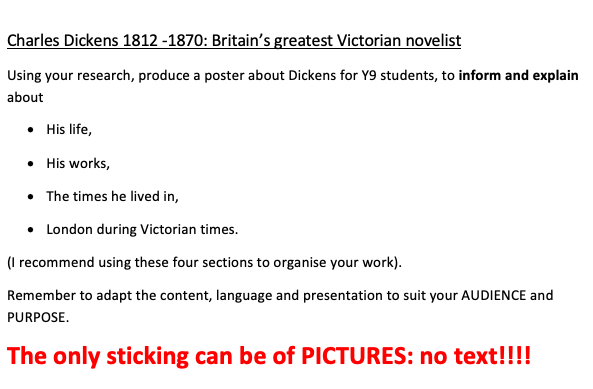
So, after finishing travel writing, which has definitely been my favourite SOW to teach, it was time to move on to 19thcentury prose. I recycled the introduction lesson, playing the Dickens’ game and research. It was a complete dream planning the second time round – I already had an idea of how to improve my planning, resources and teaching. 

This was the sheet I used last time, for the research project:

They also had to find 10 more fascinating facts for homework and print out any pictures they want to use on their posters.

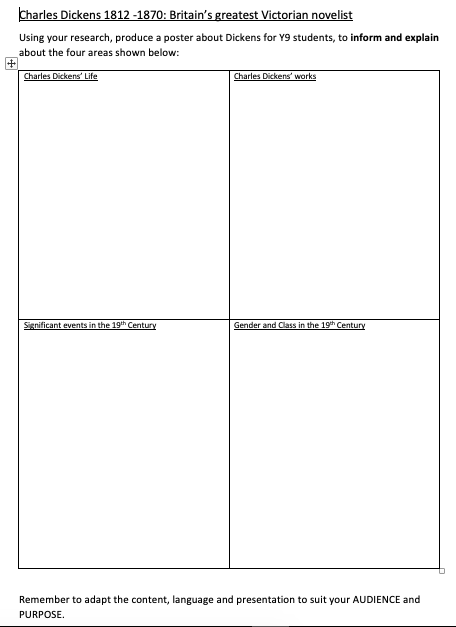
I found that some of this research was not directly relevant to the texts we study, and that it could be more useful to focus on gender and class, as opposed to London. Moreover, I had them take a page in their books and draw their own grid, with the intentions of having it filled in by the end of the lesson. I found that a lot of students spent nearly as long drawing and perfecting the grid than they did actually researching, and that a lot of them didn’t get at least 5 facts in each section – which was my minimum aim.

This is the new resource I created:

I figured that if they had a print out of the sheet, they would be able to take it home to finish off for homework (a fantastic motivating factor!). I also added to this homework, by telling them to find 5 fascinating facts about Bleak House. I am hoping that this will help them to have an idea about what the mammoth novel is about, before approaching it with them next week.

My hard work paid off – this was definitely an easier way to do the research! I also asked them to pair up and split the research, as we didn’t have as much time as I would’ve liked (Friday timings are slightly shorter and I was in a year 10 assembly that ran on for an extra 5 minutes = 10 minutes of lesson time gone… plus we had to actually get to the computer room!). The majority got at least 15 points down, and they worked well together to finish off their research… although they will be dismayed when they see I have put them in different groups on Monday! 

J

Currently Reading:

The Eolian Harp & Kubla Khan – Samuel Taylor Coleridge

Kubla Khan is now one of my favourite poems. It is a unique poem, interweaving the ‘sublime’ with the exotic, creating a beautiful Romantic masterpiece. 

Bleak House – Charles Dickens

Animal Farm – George Orwell

A Monster Calls –Patrick Ness

More than one tear was shed in the reading of this book – cancer being an illness very close to my heart. I loved reading about a boy struggling with accepting his Mum’s inevitable death. A very accessible book, an easy read but a sensitive topic… may not be suitable for all students!

Week 18 – Back at it again!

Introduction

So, I am sat writing this a day early, as I have a rather busy weekend ahead of me, and I already can’t quite believe what I have achieved in 3 days of teaching and observing (excluding the inset day on Monday!). I am over the moon to be back at school; by the end of the week, I will have taught 4 starters, half a lesson and 3 full lessons. I am extremely proud of how hard I have been working this week, and I am certain I will keep this up for the rest of the term (hopefully!!).  

Alongside the highs, I have also seen a glimpse into the lows – they have already started and will inevitably only get worse as my work load increases. My university tutor has suggested I make sure I take one night off during the week (probably a Tuesday or a Wednesday as that’s when the stress seemed to be hitting me) and actually get out of the house! Now, I haven’t done that this week, but I aim to start it next week and I will hopefully see some improvement in my wellbeing! I am also already ridiculously tired… so if anyone reading this has any suggestions other than sleeping more (I always average 7-9 hours a night) or drinking coffee (can’t abide it!) they will be more than welcome!

Inset day

It was really interesting to see what happens on an inset day, after making the most of so many of them as a student with lie ins and socialising with friends/family! The day was split into three: Housekeeping, feedback and gifted and talented students; Faculty based work (I also had a chat with my AT about my teaching this week); recent safeguarding issues and recapping ready to learn. 

I am not going to into too much detail about this, as a lot of it is directly related to the school’s recent Ofsted inspection (happened the day after the inspection for my P1 school!). However, it was interesting to see the sort of training that goes on for teaching and support staff; it was also really good to get a chance to get to know the faculty a bit better before the students came in!

EPS assignment

Following the inset day, I felt as if it would be more appropriate to go for my second idea of looking at gifted and talented students in sixth form, with an emphasis on how feedback can aid pupil progress. I feel that this will be particularly interesting, as I looked at a few different ways of giving feedback in p1 – this should definitely both help me give feedback that genuinely aids pupil progress, as well as reduce marking time for me! I submitted my proposal mid-week, so I will hold off on doing anything further now until my idea has been ok’d!

Sixth Form 

It was amazing to finally get a chance to officially observe sixth form classes – I thoroughly enjoyed helping out in 12 literature and 12 media last year when I did a bit of work experience! In particular, I really enjoyed going into the English Language class – looking at Robin Lakoff really brought back memories of why I am so passionate about my subject! I intend to purely observe the lessons for the first few weeks before beginning to teach. Teaching sixth formers is slightly different to teaching ks3/4, therefore I want to ensure that I am able to adapt my teaching style to suit each class.

9Y3 – Nineteenth century prose

I believe I have manged to grasp at my students’ interest, thanks to an interesting start to the Dickens half of 19thcentury prose, and on the way, I have been reminded about how much I love fiction from the Victorian era! My AT started off Tuesday’s lesson with a game https://www.bbc.co.uk/arts/multimedia/dickens/(need to make sure flash player is allowed, or disable then allow flash player for it to work). There is the opportunity to get 2000 points and the students had the challenge to get as high as they could get in the time limit. The winner got just over 1,200 points! 

I then introduced the research task, which was finished off for homework and helped them to create posters on Dicken’s life, works and times. We had a competition to see who had the best poster – all the students seemed to have a lot of fun doing this and, as I opened the second lesson by asking them to tell me a fact they had learned when I called their name on the register, they all seem to have good contextual knowledge in time to start on Bleak Housenext week!

9X5 – Travel writing

This topic gives me great pleasure as it combines two of my all-time favourite things: English and travel! The introductory lesson was about the differences between a tourist, traveller or explorer. I introduced the definitions of the three, before doing a quiz with the students to find out if they were more of a tourist or a traveller. This was also a lot of fun; the students all appeared to be engaged and were loving finding out what everyone was! 

The next lesson I taught was on the ‘ingredients’ of travel writing, which involved analysis of the first extract they will see. This was the first full lesson I was to take, and I was pretty nervous about doing so! However, on the whole it went really well – the students are completely amazing, I am very lucky to have two eager year 9 groups! 

Tomorrow I will be taking them again, looking at the positive and negative connotations of different words, particularly adjectives. 

10X5 – Power and Conflict poetry

It has been decided that I will be teaching the year 10s for the first-time next Wednesday, looking at ‘Exposure’. In the meantime, I have been doing ‘Haribo’ starters with them – a quiz looking at different aspects they have covered so far, tallied up each lesson and at the end of the half term, a winner will receive a packet of Haribo. They seemed to really enjoy this concept – although not many of them got the questions right. Teaching bottom set will definitely be a challenge for me – I am so used to having to stretch and challenge students predicted grades 7+ that I am going to have to do a lot of work to in order to teach them well – one of the reasons I decided to do my curriculum practice assignment with them!

The lessons the teacher is doing with them have a rigid structure that is applied to each poem, with the theory behind it being that they will then be able to apply this to any poem that they come across. Each student has chosen their own colour for each of the three assessment objectives, has split up the page in the anthology so that each AO is together, and annotated the poem, heavily scaffolded by the teacher. This has meant that each poem has only taken one or two lessons to teach, and they all seem to be getting a basic understanding of the poems. My challenge is to keep them engaged to continue this for the rest of the term!

I have also chosen to let them know I am a trainee teacher – only time will tell if that was a stupid mistake or not! I want my students to know that I respect them, so if they ask me why I am here and what I am doing, I intend to be as honest as I can and hope that they have the integrity to respect me back! So far so good, I have already got a couple saying they are excited for me to take the lessons – this may because the only teaching I’ve done with them so far has involved the prospect of sweets, but I’m taking it as a win!

Teaching Targets

I have decided to start my targets a fresh and will only do one main target a week until I get back into the flow of teaching (hopefully by this time next week but you never know!)

  • Lesson timings: pacing is one of the aspects of teaching I regularly seem to not quite get right. One of the teachers I am working with suggested that I put the time expected for the activity on the PowerPoint so that the students are completely clear, thus, in theory, helping me to not go off on a tangent!

J

Currently Reading:

Poetry – Tissue by Imtiaz Dharker

I had a look at this poem earlier on in the academic year, when myself and a colleague prepared a lesson plan for it – little did I know that it is many teacher’s least favourite poem! I love this poem. The extended metaphor is beautiful, and I love how it questions the fragility of humanity in such an elegant manner. 

Drama – The Importance of Being Earnest byOscar Wilde

Ok, so I only read one-page last night before falling asleep…. Update next week!!

Novel –Bleak House by Charles Dickens

Definitely questioning whether I will finish this book before I get around to teaching it the second time! Just got to the part where Esther meets Lady Dedlock for the first time. I have read a summary for this novel, as I will be teaching extracts from it next week, therefore it has been very interesting to me to read it in light of what I know about their relationship to each other!

YA Fiction – Girlhood by Cat Clarke

I intend to start this novel tonight, so will update next week!

References (if necessary)

Week 10 – Overwhelmed

Introduction

So, this week has been significantly more intense than last week. I have classically gone and done what I always do; agree to take too much on. At the beginning of the week, I agreed to go and talk to the Ofsted inspectors for university, which not only but a halt on my planning time, but also meant I had to rearrange my PT meeting this week. On top of this, I had my university tutor come to observe me on Tuesday afternoon and, despite her being so lovely, I found myself getting unnecessarily nervous for this. So, let’s just say the stress was ramped up a level and I ended up breaking down a bit on Wednesday. However, my lessons on Thursday and Friday proved to be a million times better and I have started the weekend with a new instilled confidence in myself.


Ofsted Round 2

Not long after getting an email, about Ofsted coming to carry out the second half of the university’s inspection, the course leaders sent another email around asking for volunteers to come and speak to the lead inspector. As I had a free in period 5, I offered to come into university, which meant that I sacrificed my planning time, to speak to Ofsted.

Obviously, I am not sure what the outcome is, but the inspector seemed very happy with what we were telling him about the course… fingers crossed to stay outstanding!


University Tutor Visit

As previously mentioned, I was a complete nervous wreck thinking about the university tutor’s visit; I didn’t know what to expect and had no idea how the class would react to my lesson – after the supply teacher incident, my confidence was knocked with this class.

My lesson was the third lesson on Shakespeare sonnets; we focused on the meaning of sonnet 18 and began to compare it to the beginning of sonnet 130. I managed to ensure that every child had contributed verbally, at least once, during the lesson, thanks to my handy ‘good names’ list on the board. I have to say; a lot of credit goes to my gorgeous year 7s… they worked so diligently and had some fantastic comments – I am continuously and regularly very proud to be teaching them!

It didn’t take long for the nerves to wear off to be fair, I got into the swing of the lesson pretty quickly and my confidence grows every time I teach something, and they prove to me in the plenary they have understood it.

I had a meeting with my UT and AT after this lesson and they both had super nice things to say. We worked through my targets for the rest of placement one and my UT noted that, if I gather enough evidence, it seems as if I am teaching at a ‘very good’ standard; for those of you not familiar with PGCE talk, this is the highest you can be. It’s safe to say that I was elated and extremely proud of myself – all the hard work looks like it is going to pay off!

I am going to leave this section with a part of the email that my UT sent me, as a follow up to the visit:

‘Joanne, you should be really proud of the lesson that you taught. You have a calm and confident teaching persona and it is clear to see that you have already established a lovely rapport with your learners: well done. You used a range of questioning techniques to ensure that all learners were involved in the lesson and made progress, and you demonstrated some live modelling with the visualiser.’


Debate Mate

One of the English teachers runs the ‘Debate Mate’ club after school on Wednesdays and, as I didn’t have a PT meeting this week, I came along to help out. Debate Mate is basically a club to help students with their debating skills and they also have an opportunity to compete in national competitions. (Click here to watch the 2018/19 launch video).

I only teach one of the students who attended, but it was super nice to be able to meet a variety of different students. It also amazes me at how much talent lies within the midst of the student body. The students that spoke, spoke eloquently and with such passion and confidence… at the ages of 11-14!


Midweek Breakdown

You would think that after all this great news at the beginning of the week I would be feeling elated and confident in my role as a teacher, that is what any normal human should feel after such fantastic news. Tuesday evening, I definitely felt that way! But for some reason come Wednesday evening I felt my panic and stress levels begin to rise and I just felt utterly overwhelmed and helpless. I negotiated with myself and only checked over my lesson plans for the next day before having an early night.

I’m not going to go into any details, I have no idea as to why this happens to me. It happened the previous week, but I presumed it was a one-off ordeal. It’s starting to become a pattern mid-week, so I am just going to monitor myself and adjust what I am doing accordingly.


Back on Track

Despite this set back Wednesday evening, Thursday proved to be a great day. The only lesson I had to teach was the lovely year 7s…. but, unfortunately, my AT was off again so I was in with a supply! I began to feel the beginnings of panic but held myself together – I knew what I was going to teach (thanks to a kind teacher who talked it through with me in the morning) and I was confident that I knew the lesson well enough, so I only really had to think about behavioural management techniques – that and pray they would be better behaved than last time!

My plan was to give them between 20-30 minutes to finish off their poetry comparisons (I’ve started marking these and some of them have blown me away – there aren’t many adults I know that can write this eloquently about Shakespeare, let alone an 11/12-year-old!), and then we were going to move onto their spacing task for this fortnight – viewpoint writing. The spacing task was to get them to agree or disagree with the statement: ‘Parents today are over-protective. Children should be allowed to take part in risky experiences to prepare them for later life.’

Yet again, I have to give credit to the year 7s. They now completely see me as their teacher – it is just the sweetest thing. I felt fully in control all lesson and, despite a few of them getting excited about the spacing task (one kid was adamant that if you went to the park without an adult you were extremely likely to get kidnapped, another asked what would happen to you if you got kidnapped) – I managed to keep them all on task appropriately so I’m calling that a win!


Progress with a Student

One of the biggest achievements for me this week is making progress with one of my more difficult students in year 9. I can’t remember if I have written about this before, so I’ll just do a quick background: one of my year 9 students has a lot of additional needs, which has related to him being off task and disruptive in lessons. I’m not going to give any details, but there are considerable reasons behind this that I am aware of and I have agreed with the normal teacher that she will help me with him. He very rarely does anything more than write the date in his lessons.

Due to him being in Ready to Learn or being excluded, he has only been in the class twice before, and I have only taught part of one of these lessons.

In fact, it is very rare to have the whole class in – more often than not there has been at least 6/31 off for various reasons.

The first full lesson I taught them… there were only 2 off and I had to adjust the seating plan accordingly. On the whole, my behaviour management was not great in that lesson, but I am going to focus on the positive in this section.

I managed to get him to verbally tell me which introduction was better and why; he responded accurately giving valid reasons behind his opinion. He took himself off to refocus during the lesson but, for me, the biggest win was getting him to stand behind a chair at the end of the lesson. It was period 5, so obviously they are all keen to leave, but I have been insisting on silence and order at the end of the lesson to maintain control of the class. He rushed to the door just as the bell went and I calmly asked him stand behind his chair. After reminding him to do this a few times, also informing him that I too would like to leave, we compromised with him standing behind the closest chair. At the end of the following lesson, I got him to stand behind his own seat.

This might not sound like very much, but I did not think I would even get to talk to me in a respective manner, let alone get him to follow my instructions and even begun to do some work. In just a week I have gotten so far with him, thanks to the teacher working with me acting as teaching assistant as well. I am hoping to see more progress, hopefully he will get to the stage where he participates in a lesson without causing too much disruption, even if he doesn’t do it whilst I am teaching them. It’s the smallest steps that feel like the biggest in learning to teach.


EPS SEND Assignment Feedback

On a final note, we got our feedback on the first part of our SEND investigations and I am thrilled to say that not only was my feedback good, but it was also extremely helpful. I have never had such specific feedback that I completely understand and agree with before. I’m not going to look at my assignment until next weekend, but I am glad that my mind is at ease with regards to this.


Teaching Targets

Last Week’s Targets:

  • Examples & subject knowledge: Subject knowledge is going to be one of those I will be constantly improving, so I am going to remove it from my weekly targets – I am aware I am going to have to adapt and learn as I go, especially as I move from school to school over the PGCE year. With regards to the examples, I am becoming more confident and finding that planning my examples into my lesson plans really helps me – even if I end up not using them and eliciting a model from the students.
  • Questioning: I have been attempting to use think time, something that is definitely a lot easier in theory than in practice, but I have come to the realisation that before I can even think about attempting some of the more advanced teaching skills, I need to work on my basic questioning skills.


This Week’s Targets:

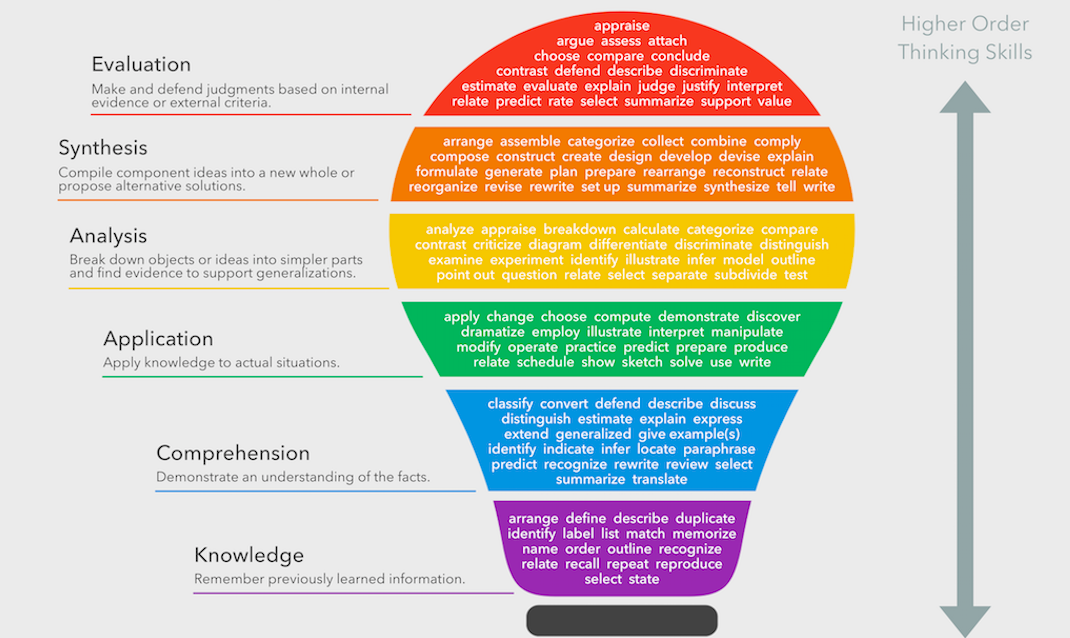
  • Questioning: Building on what I have previously said, I have noted to adapt my questioning techniques depending on what I know about the learner I am questioning: ability levels, any SEND or any prior knowledge. To do this, I am going to attempt to use Bloom’s Taxonomy, something I am going to have to read into a bit more before I can make effective use of it. My university tutor suggested I laminated seating plans so I could write next to the student what kind of question I should be asking them: to monitor who is contributing to the lesson and to what level their answers will be. I am going to attempt to include this into my planning – hopefully it will be effective!
  • Assessment for learning: another target that has cropped up this week, is that I have been neglecting to use assessment for learning techniques to gauge if learners know what they are supposed to be doing; particularly when I give input or set an extended piece of writing. On Friday, I used a few techniques (thumbs up/middle/down; temperature check; common problems) to assess this, and already I am seeing a difference in how well the students are understanding my instructions. As noted in some of my earlier blogs, one of my biggest concerns is that I am not clear enough in how I speak to the pupils, thereby I am wasting my time and their time by having to consistently reword my instructions because I wasn’t clear enough the first time.
Bloom’s Taxonomy

J

Currently Reading:

The Penguin Book of First World War Poetry

Reading first world war poetry on Remembrance Sunday – the centenary of the end of WWI no less – made the readings ever so more poignant. Poetry is one of those beautiful forms where the poet can express a multitude of emotions in written word – often, in my opinion, much more effectively than prose. I find that poetry is not the same read inside my head, so I often read poetry aloud to myself, in doing this last Sunday it made me realise how important this poetry is in remembering those who have gone.

The last surviving English veteran of WW1 died in 2009; in keeping the heightened, harrowing images of ‘the war to end all wars’ alive through various creative means, we are able to remember and be thankful to all of those who fought for us to live the lives we live today, also, hopefully, serving as a reminder to what we should never have to live through as a species again.

The Importance of Being Earnest – Oscar Wilde

So far so good! I’ve not read much but I am looking forward to reading some more this week!

Mrs Dalloway – Virginia Woolf

I have finally finished this novel and I reluctantly say that I did not particularly enjoy this novel. However, I can totally appreciate why people do love Woolf’s writing, the description is detailed and eloquent and her characterisation is phenomenal – I just did not overly enjoy the story.

Dark Woods – Steve Voake

The main gist of the story is that two children go off exploring in the woods near their campsite and a man finds them and drugs them, bringing them up to his cabin deep within the mountain forest. He then shows them that he can bring dreams alive; all he wants them to do is go into his dreams and bring his dog back to life. But there is a twist: he has brought Cal’s nightmare to a reality, and the kids set it free to torment them as they try to escape.

This is a novel that you really have to suspend your disbelief for and I find, when reading children’s and young adult novels, that I read them slightly differently to how I would read other novels; I imagine what my childhood self would’ve thought about them. Bringing myself back to opening up my imagination in any way possible, I am finding I am actually really enjoying this book. It is a simple horror for young people and holds the same gripping nature I would find in that of a Stephen King novel, only made accessible for the younger generation.

Exiting Nirvana: A Daughter’s Life with Autism – Clara Claiborne Park

The chapter I read this week was about her daughter’s experience with language – how long it took her to be able to communicate her unique way of seeing the world. The more I read into autism, the more I feel as if we are extremely fortunate to have these individuals in the world; different perspectives bring layers of meaning to an otherwise mundane world.

Week 9 – What a week!

Introduction

I’m not going to lie, this has been the longest most intense week. My placement school got the call from Ofsted Monday morning, which led to panic stations all around and, even though I wasn’t directly affected, I think I subconsciously picked up on everyone else’s stress. I also helped my AT with a poetry workshop ran by Black Artists on the move… which was also fairly stressful, some of the reasons I will note below. Then, to top it all off, I had my comfort blanket (my AT!) taken off me on Thursday, as she was off sick. I have so many different emotions and thoughts running through my head, I feel like this blog post may end up being fairly rambly… bear with me, I may say something of use or interest somewhere!

Ofsted

I have avoided Ofsted for the whole decade I have worked in childcare, unintentionally already having a day off in place when they have come in to the settings I worked at. One of my friends even informed me that I narrowly missed Ofsted at the primary school I was placed at – her daughter attends that school.

Monday morning.

The end of period 3.

The gossip started.

“Have you heard, they’ve had the call”

“What call?”

“Ofsted are in. For 2 days!”

Long story short, the main gist of it was, (I mean I think this was the main gist, I am getting my information from a wide variety of sources!) that they wanted to do an in-depth inspection due to the 2017 results. They focused on the disadvantaged kids and high ability kids. They have made a decision, and we do not know what it is yet – that will take up to 15 working days to come through. We did have a feedback session about it Wednesday morning, but I am unable to share anything as it was strictly confidential. However, I will definitely post the result in the blog after I find out!

Despite the stress it caused my colleagues, I actually feel as this couldn’t have come at a better time in my career. I got to witness first-hand the impact Ofsted has on the English department as well as the whole school. There were some teachers that have been qualified for longer than 4 years and still never encountered an Ofsted inspection, so I feel fortunate to have been able to witness this.

Despite this, after getting an email saying that Ofsted have spoken to the university to say they are getting the second half of their inspections, I really hope that they will not be coming to my placement school to look at the Bristol uni NQTs there!

Black Artists on the Move

On Wednesday we had a poetry workshop run by the CEO of Black Artists on the Move, Akulah Agbami and, as she kept what she was going to do a mystery from everyone, we had literally no idea what to expect! All that we knew was that there would be 2 workshops for 2 different sets of year 8s, handpicked by their teachers, and then there would be a showcase period 5 – a chance for them to show their work to their peers.

Speaking to one of my tutees, who is also in my year 8 English class, she expressed how concerned she was about speaking in front of everybody. I can totally empathise! I would have completely hated that at her age. I reassured her and said that if she honestly felt that strongly about it, she wouldn’t have to do it.

In the first session, she asked the students questions to warm them up, before taking key points and writing them up to create a class poem. To emphasise the fact that poems don’t have to rhyme, and that repetition is a key point in poetry, she randomly decided that they would say each line a certain amount of times. The end result was pretty cool and, eventually, the kids seemed to be actually engaging and enjoying themselves.

They were then given three different scaffolds to base their poems on. A lot of the students wrote some really beautiful poems and were inspired by what they were asked to write. However, I feel like the better poems digressed from the scaffold a bit, so I feel it would’ve been better if they were given as a suggestion rather than being told to work that way.

At the end of the first workshop, the kids were told they would be sharing their poems in the showcase and, naturally, they were reluctant to come forward and the initial few volunteers took a little coaxing to come forward. Akulah seemed adamant that everyone should be proud of themselves and show their poems to each other, so much so that when the bell rang, she let the volunteers go and asked the others to stay behind to see if they would change their minds.

The next session was much the same, they made another group poem and the same kind of process took place. Although this group seemed more confident, they were still pretty reluctant to do the showcase.

The showcase ended up being a shorter workshop, asking the kids to write a poem in response to a Fairtrade video, and one of the kids in my English class won the prize for the best poem! I was very proud. Then the students had a mini-assembly on the impact of poetry and then some of the workshop students bravely read out their poems to the rest of the year.

This was an interesting day, being able to see the students outside the classroom was great, as well as being able to see some of the work of students I do not teach. On the whole, I feel as if they enjoyed themselves – although one student said defensively ‘miss told me it was going to be fun!’ – so maybe it wasn’t for all the students!

Supply in the Room

Unfortunately, my AT, who has been suffering all week, was too unwell to come into school Thursday, which meant that a supply teacher would be covering her lessons. Initially, we discussed whether or not I would be happy to still take the lesson, as Jo had set cover work, and, me being me, I smugly said I would be happy to still take the class, as they are such a lovely group, as long as it was alright with everyone else.

The head of English agreed with me, saying that it would actually be more beneficial for me to save face in the class by continuing with them, as I have fully taken over this class. I was to teach sonnet 18 to them, focusing on the structure of sonnets, and I was fairly excited about this as I absolutely love Shakespeare’s sonnets.

I’m not totally naïve, I did expect the class to act differently without my AT there as well, I just thought that they would try it on and then go back to normal when they realise, I am running the class as normal. And, to give them credit where credit’s due, they weren’t that bad either… they just wouldn’t shut up! All they seemed to do was talk talk talk. It was driving me up the wall to be perfectly honest! I gave out a few RtL warnings and they settled a bit, but every time I had to sort something out (technology was not my friend today… never thought I would be that teacher!) they would just start whispering again… and those whispers got louder and louder.

Like it wasn’t the end of the world, and the supply said that I did a great job (even if she kept her face completely emotionless throughout the whole lesson). It was just disheartening to go from feeling like their teacher, to feeling like an outsider again.


Ready to Learn

Luckily my AT was back on Friday’s lesson, and it was a library lesson too – basically just doing crowd control! We agreed that I needed to make myself known as an adult in charge and, due to this, I would really crack down on behaviour in this lesson. The rules are simple in the library – work in silence and work hard!

One kid in particular, I’m going to call him Harry*, for no reason other than I love Harry Potter and I can’t use his real name in this post, is regularly and consistently off task and chatting away to anyone who is remotely close to him, distracting both them and himself. He gets a warning almost every English lesson – from either my AT or myself – and has been sent to RtL twice before.

I don’t want to tell the kids off. I get that it can be boring or it’s just generally hard to maintain concentration for large periods of time – I am horrific at procrastination myself and I’m over a decade older than them.  I gave him an informal warning before giving him a RtL warning, willing him to just do the right thing (next library lesson I’m going to make sure he is sitting away from people who will engage with him!).

I then had another discussion with my AT, and again we agreed that I should be the one to send anyone to isolation if they are not following the rules (by this point there were a few more names on the RTL warning list). With a few minutes to go before the end of the lesson, AT had begun to tell them about homework expectations, as I was unsure about what they needed to do. I was keeping an eye on all of them, as they were spread out around the library, and Harry* started laughing and speaking to another kid, who was stifling a giggle but not responding to him. I quietly went over to him, said that he had had a few warnings and that he was still talking over AT, being rude and that he had to pack up his things and go to isolation.

Naturally, he did not take this well and stomped off to pack up his things. I repeated that he was not ready to learn etc. and also that I had given him extra chances and he was still talking when he wasn’t supposed to be.

I can’t help but feel slightly guilty – to me, it feels irrational to send a child to isolation just for talking. I know that is the point in RtL – cutting down on low-level disruptive behaviour – and I am also confident in my decision – I had given Harry* amples of warnings on top of the official warnings, in both this lesson and previous lessons. I also get that just giving a warning and not sending them to isolation defeats the object of RtL, but I still feel for Harry*.

Later on, AT informed me that she had received an email from Harry*’s mum, asking why a ‘cover’ teacher had sent him to isolation. AT replied saying that I was a trainee teacher and would be taking the class for the next month – hopefully nothing more comes of this!

A View from the Bridge – Beginning of Act Two

On a lighter note now, as I’m sure those of you who have read AVFTB are aware, the beginning of act two has Rodolpho and Catherine having sexual intercourse for the first time, and Eddie catching them just at the end.

Reading this with year 9s, 13-14 year olds, proved to be highly amusing. This play covers many mature themes, and I am very proud of them for being able to understand and apply them in their writing. Now, the reason I am writing about this week is to thank the teacher I was working with for letting me team teach this session, as I would not have bene able to compose myself as she did!

So, after blowing their minds by telling them that the fact that Rodolpho and Catherine were in the bedroom together, and that Catherine had to ‘adjust her dress’ after coming out of the bedroom, implied that they had engaged in sexual intercourse (a good three quarters of the class were unaware of this), the teacher asked them to compare how Catherine is feeling after being caught by her uncle as opposed to how she should feel after losing her virginity with someone she loves deeply. A few students said she should feel happy etc, but one student said that she would feel ‘sticky’.

LUCKILY, a handful of people heard (I didn’t!), and the teacher kept her composure beautifully, telling him that that was inappropriate and giving him an RtL warning (the poor boy looked a bit confused as to why it was inappropriate) and she moved the class swiftly on and eventually everyone forgot about it (or just ignored it!).

The main reason I am bringing this up is that I had literally just read the scene with them, and passed over to the teacher to set the writing task, as I wouldn’t be with them in the lesson they will write it in, and it got me thinking – how would I deal with a situation like that?

Anyone who knows me knows that I have a slightly immature sense of humour, and yes, I definitely find things like that hilarious. Therefore, I feel like I have to start practicing maintaining a straight face for circumstances like this – any tips would be gratefully received! (side note – I did manage to keep a straight face when the class were roused by Eddie kissing Catherine and then kissing Rodolpho! So hopefully all is not lost!)


Teaching Targets

Last Week’s Targets:

  • Examples: Still need to work on this to know exactly what I want to do!
  • I’m confident on the majority of the names of the year 9s now, there are still a few I’m unsure on but the seating plan I have made really helps!
  • Subject knowledge: This will be an ongoing target as there is a lot of stuff coming up that I’m not 100% sure on!


This Week’s Targets:

  • Examples & subject knowledge – to keep adding to my subject knowledge and to attempt to make my examples as relevant and useful as possible.
  • Questioning: One of the teachers, who observed me this week, suggested that I mix up my questioning techniques in order to stretch each pupil to their maximum potential. One interesting thing she was telling me about was think time – not giving praise straight away so that the students build on their responses independently.


J

Currently Reading:

Contemporary Poetry: Poets and Poetry since 1990 – Ian Brinton

I gave up reading the theory, as I feel like my time is better used elsewhere at the moment, as I am not actually teaching contemporary poetry as of yet. I’m not sure if it was because I wasn’t in the right mindset when I was reading it or what, but I wasn’t overly enamoured by the majority of the poetry. However, it did reignite my love for Carol Ann Duffy’s poetry – The World’s Wife  was one of the first anthologies I fell in love with, and also I stumbled across the poem Prac Crit by Anthony Wilson. I have not come across this poem before, as I can remember, and it is a poem about analysing poetry – I love it!

The Importance of Being Earnest – Oscar Wilde

Although this is the next play I will read, I have not had time to start it as of yet.

Mrs Dalloway – Virginia Woolf

I am totally aware I am taking an embarrassingly long time to read this novel and, honestly, I do feel this is because I am not feeling overly engaged by the text. I want to love it – I really do! I’ve heard so many fantastic things about it from a range of people, but I just can’t get into it. I appreciate that it is written beautifully, but the story isn’t gripping me, so if anyone can recommend me a Woolf book to change my opinion it would be most appreciated!

Dark Woods – Steve Voake

I have been wanting to read some of Voake’s novels since he came into university to talk to us. This one was on the top of the pile in the YA fiction library we have at uni, so I thought I would give it a go! I’ve only read a couple of chapters… and the chapters are a couple of pages long (I’m not so good at reading before I go to sleep anymore!) but so far so good!

Exiting Nirvana: A Daughter’s Life with Autism – Clara Claiborne Park

I bought this as I came across it on blackboard when researching autism for my assignment. It is a memoir about Clara’s autistic daughter Jessy, and her life as an adult. I am enjoying it so far… but again, finding the time to just read is proving difficult!

Week Six: Early Days Yet

Introduction

This week I worked in school Tuesday – Thursday, which meant that I have taken place in ‘Curriculum Enrichment day’, where one-year group spends the day in two subject areas, tutor evening and a whole school photo. Interestingly, this whole school photo on happens once every 5 years… just happening to fall on a day that I was at the school. I was also wearing a very subtle blazer… the shade of vivid canary yellow. Great… I will now be the member of staff that no one can remember! We missed a lesson and a quarter due to the photo, something I feel the kids appreciate more at the moment than the photo itself! It also provided me with having to make small talk to a lot of members of staff that I have no idea who they are or what they do… one thing I am forever grateful for is that everyone at the school is genuinely welcoming. I am also feeling relieved at the fact that a lot of the people I have met have graduated from the same university I am studying at… makes the future job prospects seem a little less further away than anticipated!


Assessments

In our university sessions this week, we had been focusing on assessments and looking at progress 8. We had been discussing how useful formative versus summative assessments are, as well as focusing more on what how assessment works at our various placement schools.

It was very interesting to hear about the different ways schools go about marking work. Some schools just give feedback on SPaG, whereas others focus on positive reinforcement – with the majority doing a mixture of both. Some give out grades for every piece of work and others just use comments, as they say the students were focusing too much on the grade and not enough on how to improve themselves. I think that a mixture of everything is healthy – and I also believe marking should be differentiated appropriately. For example, a higher attaining student would benefit from a focus on SPaG, if that is what could potentially bring their marks down, whereas a student with mental health issues may benefit from a lot more positive feedback so that their self-esteem does not go down.

The way the schools are now judged on attainment is, I feel, a lot better than the old system. When I was at school, a student had to get 5 A*-C grades to count. This potentially meant that lower attaining students might not have got all the support they needed, and they may have felt like a failure as schools were pushing students to expect to get a C grade. The way they work it out now is to do with how much progress they individually make. Each student gets a calculated predicted grade for year 11, and ‘progress’ depends on if they meet this grade, which potentially means that the higher attainers in year 6 have a harder time meeting this than a lower attainer. Obviously, the system isn’t perfect, and I feel as if it would be hard to create a perfect system in ‘judging’ schools, as there are a lot more factors in how a student does in their exams than just the school’s input.


Curriculum Enrichment Day

On Wednesday this week, the school I am at had a Curriculum Enrichment Day (CED). This is where each year group spends half the day looking at one subject but doing things a little differently to a normal lesson, sort of like intervention sessions. English had year 9, and we spent the day looking at context for poems they will study for GCSE.  It was super fun, most of the students seemed engaged, which was probably down to having a few more video clips to analyse than they would normally have! We also finished with a Kahoot! Quiz… they loved it so much that I have decided to put one in place to do in a revision session for A View from the Bridge.


‘Marco’ Starter Critical Analysis

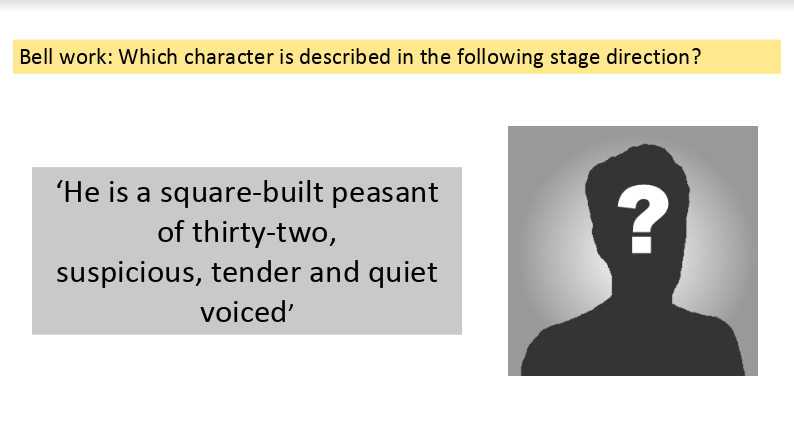
My criteria for creating a starter for this lesson was to focus on the character of Marco in order to remind the class about him before getting to the ever-important chair scene at the end of act 1.

My first minor mistake was writing the title ‘Marco’ on the board, as the regular teacher asked me what the title of the lesson-was and I eagerly offered to write it out on the whiteboard. I swiftly realised that this then gave away the answer to my bell work question… and I didn’t intend them write anything down until we moved on to the language use… oops! My not so subtle groan and remark to the other teacher about how ‘I gave it away’ now lead to a few laughs in the class so at least I’m building up relationships with the class?

Screen Shot 2018-10-18 at 21.19.52One thing I am going to note here is that my classroom management for this class did not feel very natural and I know that this is down to me only knowing a handful of names. Seating plans, without photos, are only helpful if everyone is sitting exactly where they should be, and this isn’t always necessarily the case. One thing the head of English (HoE) said to me was to ask them to remind me of their name if I am not sure. Side note… I also find a lot of names extremely hard to pronounce, so if parents could start naming their children one syllable regularly pronounced names that would be great!
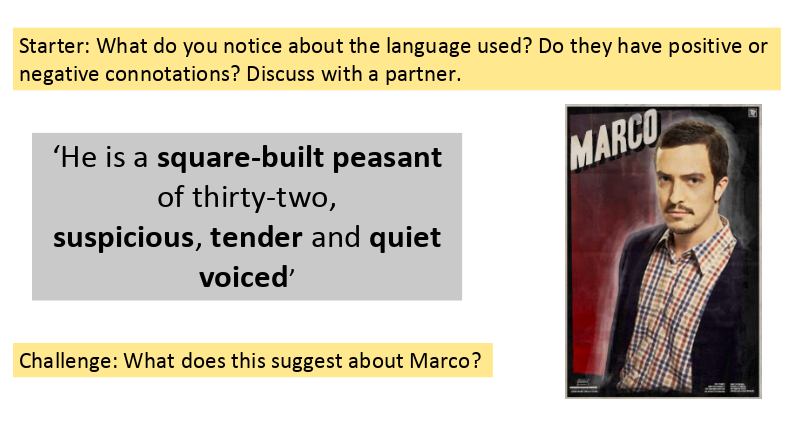
Nevertheless, I strode on with the lesson and, despite muddling my words up every now and again (still working on that… and I imagine it will be something I will be working on for the rest of my life).  I introduced the next part, where we were looking at the language used and whether they felt it had positive or negative connotations. I asked them to discuss this with a partner for around 5 minutes, and I went around the classroom ensuring I spoke to a range of different students.

Focusing now on one of the students I talked to, I was particularly proud with the progress she made. She did not engage with the text originally, but when I broke it down for her, asking what the connotations for each individual word have, she came up with a fairly strong analysis of his character. I then asked her to share this with the class and she seemed very proud of herself for being able to share a valid response with the class.

Another student analysed the picture instead of the stage directions, so it made me aware of both being completely clear with my instructions, and also ensuring that the PowerPoint slides are clear – I could potentially have made the image smaller, not used an image at all or even explicitly stated do not use the image.

Screen Shot 2018-10-18 at 21.20.01In order to provide a better understanding of why Marco and Eddie’s relationship begins to get a bit strained at the end of Act one, I decided to focus on what kind of relationship Marco and Rodolpho had, and where the power lies with the siblings. I had discussed with their usual teacher during their previous discussion to tell them that I will expect silence in this part. I did this, but, as they are sharing the class reader between two, in my opinion it was hard and potentially unfair to enforce silence. In hindsight, I feel like this task should’ve been a discussion and the previous task could’ve been in silence.
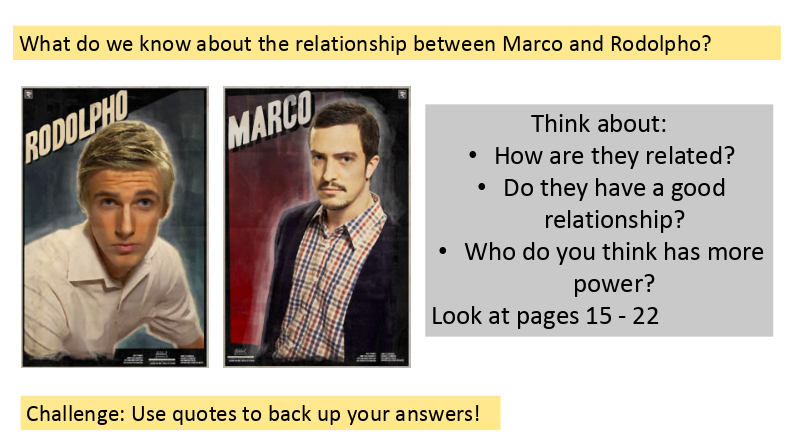
Screen Shot 2018-10-18 at 21.20.08When it came to getting feedback from the group, I used the seating plan to randomly pick on people who hadn’t contributed much so far. This kind of backfired on me, as one of the pupils I asked had quite clearly not been doing the work and could not give me much more than ‘I don’t know’. I said to him to have a quick look now and then I will come back to him later. Firstly, I forgot his name when I went to get back round to him, and then he was still adamant that he did not have anything to contribute. I was not sure how far to push him, but I also did not want to lose their respect so early on in teaching them, so I went over to him and pointed to a stage direction that would help him. He eventually gave the class an answer, even if it was not particularly well thought out.
It was around this time that the class started to lose concentration, and one of the things the teacher observing me said was to make sure I wait for silence, use my language and my body language to be clear about what I expect in the classroom.

Ultimately, I feel as if the students did revise the character of Eddie, and they used that understanding later on in the lesson when they read the play. Despite a few classroom management issues, I feel that this went ok for my second time.


Drop Everything and Read

I’m not sure if I have mentioned this before, but drop everything and read is where the students spend 20 minutes silently reading, regardless on the lesson they are in. I absolutely love this idea. Reading is something that generally is only done in English lessons and, despite being asked to spend at least an hour a week outside of school reading for pleasure, this is not something every student does – or even has the ability to do.


Tutor Evening

This week I stayed behind to see how tutor evening works. The class I am with for tutor time is also one of the classes I will be teaching in English, so I felt it was extremely useful to learn a bit more about each child that came. I was only going to stay for an hour, but I ended up staying for the whole time as English came up as an issue with a few of the students. I feel like the more I get to know the students, the better equipped I will be able to teach them. It was also good to be able to spend some time at the school in a less formal setting. They have subject evening next term, and I will be interested to attend that to see the difference!


Transferable Techniques

  • Kahoot! – Being mindful of the fact that the kids have a great time choosing their names (trying not to laugh at some of the more inappropriate names is going to be a challenge for me!)


Teaching Targets

 Last week’s targets:

  • Teach at least 2 more starters next week.

Target complete! Well, I only actually taught two more starters, but that was mainly down to being off timetable Wednesday.

  • Ensure I am confident in all aspects I will be teaching before I begin to teach.

Before taking the two starters, I ensured I read through the content thoroughly the night before, even reading the out loud to myself to make sure I don’t jumble my words up too much (my cousin must think I’m mad when she hears me!). However, I am 100% sure that I did not complete this target. I feel this is mainly due to making it a bit too broad, thus being unachievable in my second week (something I fully intended not to do!). There is no way I am going to be confident in all aspects of what I am teaching at this stage. There is far too much going on in the classroom and I have learned my lesson this week to concentrate on just a few things at a time, which I am going to choose for next week’s targets.

Next week’s targets:

  • Scripting ‘teacher talk’ so I know what I will be saying when, and also scripting ‘student talk’ so I have a clear idea of what I want the students to be saying to me, so I know they have learned something.
  • A focus on minor behavioural issues: Remember to use the Ready to Learn system already in place, and also ensure that the students are silent when I speak as well as before I start speaking.
  • Learn all the names of the students I will be teaching. Slightly ambitious, I know. But, as stated earlier, class management felt 100% easier and more natural with the year 7s, as I am fairly confident I know all of their names now. I am in school all week next week and honestly, I this is the only thing I achieve next week I believe I will thank myself a lot for it! (Let’s just hope I don’t forget them all again over the half term!)

J


Currently Reading:


Contemporary Poetry: Poets and Poetry since 1990 – Ian Brinton

Still ploughing through the theory… kinda just want to get on to the poetry now.

The Point – Kate Tempest

I don’t know what it is about poetry, but the more I analyse it the more I grow to love it, and this is definitely the case with this poem. I looked at it briefly last week, with the intentions of taking half the lesson and, in preparation for playing it in the lesson, I listened to Kate performing the poem. Listening to poetry poignantly read out always provokes an emotional response to me, but the more I listened and reread it, the more its beauty stood out to me.

The Tempest – William Shakespeare

I don’t know if I’m the only one who does this, but to appreciate Shakespeare plays fully I need to read them aloud and give voices to each of the characters (another way for my cousin to find me slightly insane). I have whizzed through acts 2 and 3 now, and I have to say my favourite parts are still with Caliban! The scene in which Ariel winds up Caliban, Stefano and Trinculo is absolutely hilarious, and the fact that Caliban keeps insulting Prospero and treating Stefano like a King is equally funny. I am thoroughly enjoying rereading this play!

A View from the Bridge – Arthur Miller

I am going to have to add this to my list at the moment, seeing as we are reading it in the year 9 class I am team teaching in. We are just at the end of Act 1, and I reread the closing scene of the act whilst preparing for the lesson starter I designed. The power struggle in that scene provides gripping entertainment. The more I read this play the more I completely fall in love with it! 

Demon Dentist – David Walliams

I read just over a third of the book in the half an hour I designated towards teen fiction this week, and I have to say it is a blessing to my overworked brain to be able to zone out and just read something ridiculous! I can totally see why this novel would be popular with the young people. It plays on the idea of a fear of dentists by creating a hyperbolised evil character that has all sorts of gruesome ways to ensure the children go to the dentist. I also appreciate the fact that Walliams has made the protagonist’s father a single Dad in a wheelchair, and a social worker is called in to help them. I always find it refreshing to see children’s authors taking a step away from the nuclear family – something I know authors like Jaqueline Wilson have always made an attempt to do.


Week Four: Poetry, Planning and Placement Preparation

Introduction

Another week has flown by, and my head has once again been bombarded by pedagogy – starting placement next week will be a refreshing change! Sitting here on Friday, as I begin to write this blog post, I am looking back over the week and Monday feels like months ago. Yet, at the same time, I cannot quite believe that the past month has passed by so quickly. I am definitely looking forward to relaxing this weekend with a few of my old uni friends!


First Tutorial

We had to sign up for one-to-one tutorials with our tutor last week, and I was eager to get this done as soon as possible, mainly so I could clear my head with someone who knew what was expected of me. We talked for quite a while, and I expressed some of my concerns about getting in front of a class for the first time. I am so used to observing, or acting as a teaching assistant, that I am starting to freak out a bit about making the transition into teacher! She made me feel heaps better about it, and we decided that the best approach for me is to jump in at the deep end and teach sooner rather than later. As much as I hate to admit it, that will probably be the best way for me to get over these ridiculous nerves as quickly as possible! Watch this space… I could be saying a completely different thing next week!


National Poetry Day

I wouldn’t be an English teacher if I didn’t acknowledge that it was National Poetry Day on Thursday! In spirit of this, our lecturers gave us a small anthology of four poems all written by female poets and taken from the current AQA GCSE Poetry Anthology. The poems were:

– The Emigre by Carol Rumens

– Poppies by Jane Weir

– Tissue by Imtiaz Dharker

– Kamikaze by Beatrice Garland

I focused on Kamikaze to begin with, after quickly reading through all four I found I was particularly drawn to the narrative. It follows a story about a Japanese girl’s father, who left to be a suicide bomber but came back, bringing shame to the family. I fell head over heels in love with the poem. The language is beautiful: ‘strung out like bunting on a green-blue translucent sea’; ‘dark shoals of fishes flashing silver as their bellies swivelled towards the sun’; ‘cairns of pearl-grey pebbles’, as well as presenting a powerful thought whether it would have been better for her father to die a ‘hero’ or live but bring shame on her family. I always find it interesting looking at different perspectives on the war, particularly after visiting Laos and seeing the devastation the ‘bombies’ from the Vietnam war, amongst other places.

We were then given the task to work in pairs to create a lesson plan for one of these poems. As much as I loved Kamikaze, the poem my partner and I chose to write the plan for was Tissue. It is such a beautiful poem, and I love the use of homonym ‘Tissue’ and the process of it starting as paper and becoming skin. The more I read it, the more I came to appreciate it. I will explain the lesson plan we made a bit further down.

On National Poetry Day we were asked to get into groups to perform different poems, and we were all given different ways in which we should perform. I won’t go into detail, but it just reminded me how powerful it is to see a poem performed, and how that could be used as a way to get my students to actively engage with the text, rather than just listening to it being read by me.

img_2288.jpg

The Planning Process

We spent a lot of time in our sub sessions talking about lesson planning, focusing mainly on medium term and specific lesson plans. I am going to focus on the lesson plan I created with my partner, and the turmoils we faced whilst we attempted to perfect the timings and activities.

Our initial idea was to explore figurative language in Tissue. We drew upon ideas, decided to do various activities and then hit a brick wall. How where we going to cover everything in a one hour lesson? After getting a bit of help, we realised that it would be more beneficial to us and the students if we were more specific with what we wanted the learning outcomes to be – in other words keep it simple and specific. So we narrowed it down to imagery. Turns out this is just as vague so eventually we narrowed it down to the senses and then our plan took place!

I’m including a picture of our plan, it is hella messy because we changed it heaps, it is also not 100% finished as we discussed a lot but ran out of time to write it down! However, I am confident that we have refined our plan and it is now a teachable lesson. This was also due to, I believe, finally getting a mock up class list so we had an idea of how we could differentiate the lesson. This made it somewhat easier, but I think it will also be a million times easier (note easier not easy) when I know the children I will be teaching well enough to adapt the lesson for everyone. (I know that probably sounds optimistic but we’ve all got to aim somewhere!)


Class Readers

We also had a look at class readers, the text (generally a play or novel) that a class will read together and follow along at the same pace, usually over a few lessons. We discussed various ways to approach class readers and also talked about the advantages and disadvantages of using them.

We then got the first few chapters of Pigeon English by Stephen Kelman, and were asked to try out a few techniques to read them in a group. I think the resounding thing  our group found was that, even as literature lovers, we found we got distracted easily for a range of reasons. The text itself was phenomenal and I have definitely decided to put it on my to read list… so why did we find it so hard?

Reading out loud can be a nerve racking thing, everyone slips up now and again and it is easy to get bored if someone is reading too fast or too slow. For me, the best way we did was the ‘popcorn method’, where the reader can nominate anyone to read and each person only reads as much as they want to. This kept us on our toes and, interestingly, we found ourselves picking on our colleagues that did not appear to be paying attention. Now who knows if this is something the children will do or if this is just the teacher within us all making an appearance!


Inclusion and SEN/D

For our first masters level assignment, we will be following ‘learner x’, a pupil with SEN/D (Special Educational Needs or Disability) and we had the introductory lectures to this task this week.

My favourite of the lectures has to be the one where we had people from a SEND department come in and talk to us, bringing along a few students with additional needs. Hearing the students side of their school life really hit home – I know inclusion is important of course, but knowing the little details that could change the child’s day for the worse only emphasised to me that it is of the upmost importance that I get to know my students as well as I can.

I am actually looking forward to this assignment, and eagerly anticipate next week when I hopefully get to meet my learner x.


Observation Versus Judgement

This will just be a brief note here, mainly to remind myself if I ever forget. Observations are what you actually see, judgement is what I think I see. For example, an observation would be that children have their heads down on their table, a judgement would be that these children are not engaged. Use the observations to back up judgments ad explicitly state what I have seen in my assignments – every judgement needs evidence!


First Impressions

Most excitingly this week we got to meet our personal tutors for our first placement, well I say personal tutor, in my case one of the deputy heads came to greet us due to unforeseen circumstances. It was honestly such a relief to be able to have a little chat before starting next Tuesday, and having a few trivial questions answered.

The school I will be working at has a ‘ready to learn’ behaviour management scheme in place, which is basically a zero tolerance method. I am grateful that all the behaviour management is in place for me to use already, as I feel like that is one less thing I need to worry about when I teach for the first time (scary how this is getting closer and closer!). It is also a Catholic school and I am excited to see how faith is integrated into the English curriculum.


Transferable Techniques

  • Working with a collapsed text: Using all the words of a poem (or any other text) put in alphabetical order and ask the students to create a piece of creative writing only using the words provided. Also, using a word wall – where all the words of a poem (or other text) are blanked out and words are revealed one by one (or however you want to do it).
  • The ‘popcorn method’ for class readers


J

Currently Reading:

The Penguin Book of First World War Poetry – Edited by George Walter

Back to the world war poetry again, I think I’m gonna alternate each week between this book and the contemporary poetry book. One poem that particularly stood out to me this week is August 1918 (In a French Village) by Maurice Baring. It is a short poem, only having 2 stanzas, but the contrast between the 2 stanzas was what really grabbed my interest. The first is a beautiful description of village life, and this is juxtaposed with distressing imagery of war and death.


The Tempest – William Shakespeare

I have just begun Act 2 of the Tempest, and I am further reminded of the interesting character of Caliban. I can remember having discussions at school whether he was evil or whether he was merely an innocent being that Prospero is abusing. I also can quite confidently say that I have no idea how the play is going to turn out! To be fair to myself, it has been over 10 years since I last studied the play. I am excited to remind myself about the play and to follow the characters into the unknown for the second time in my life. This just goes to show that rereading a text is never a bad idea!


Mrs Dalloway – Virginia Woolf 

The more I read this novel the more I fall in love with it. Woolf is quite clearly an ingenious writer, to cover so much detail over a course of a day is astounding! The part I read this week focuses on Mrs Dalloway’s daughter Elizabeth and how she has her own independent mind. Her relationship with Mrs Kilman is a bit confusing, potentially because I have the bad habit of skim reading, or could be that way on purpose! I am still not sure if Mrs Kilman loves her or is jealous of her… or both! I am also waiting for the climax of the novel… I feel as if there is something building and Mrs Dalloway will be the cause of some great distress. Time will only tell if I am way off the mark or not!


Junk – Melvin Burgess

This book was harrowing. The book follows Gemma and Tar as they both run away from home and go live in squats and, not surprisingly due to the title of the book, become heroin addicts. I don’t want to give too much of the plot away, but the changes you see in the characters – particularly Tar – just emphasises how ‘junk’ can destroy someones life. There were moments where I was nearly brought to tears (probably would have been brought to tears if I wasn’t reading it on the bus!) and it really opened my eyes to how important safeguarding is within a school! (Definitely would have had a different reading if I read this as a teen!) If someone at their school noticed that Tar was being abused at home, would he have run away in the first place? How different would their lives have been?

This is definitely a book aimed at an older reader, with themes such as drug addiction, prostitution, abuse, rape, pregnancy and abortions, a heroin addicted baby, homelessness amongst other things found throughout the novel. I would definitely be reluctant to recommend it to students until I knew they were mature enough to handle these deep issues. Nevertheless, it is a fascinating read and I am intrigued to watch the BBC adaption in the near future!


Week Three: Facebook Isn’t Cool Anymore

Introduction

After meeting a few of my PGCE colleagues at the weekend, I was eager to start on Monday. Still buzzing from the excitement of primary placement and desperate to start work in schools, I was eagerly anticipating the week ahead and finding out in more detail about how the PGCE is going to work.


EPS, Sub & Placements

The course itself is split into three parts: EPS (Educational and Professional Studies – the ‘core’ teaching theory that is applicable to every PGCE student), Sub (the subject you will be teaching, obviously English in my case) and school placements. We have two weeks of initial university work before going to our first placement school on the fifth week.

I am equally nervous and excited for my first official placement in a secondary English classroom, especially when I found out I would be teaching a lesson or part of a lesson by the end of this placement. Will I be able to put into practice all I have learned and said I could do? What will my lesson be about? Will it be something I am confident in or will I have to learn something new myself in preparation? How much support will I be given? What will my class be like? What age group will I be teaching? Will I know any of the students through the volunteering I have done in this city before?


Teacher Standards 

In order to be seen as a competent teacher, there are certain standards one has to meet. These standards are used throughout a whole teaching career, and the way you meet them develops as you gain more experience. The standards are:

Part one:

  1. Set high expectations which inspire, motivate and challenge pupils.
  2. Promote pupil progress and outcomes.
  3. Demonstrate good subject and curriculum knowledge.
  4. Plan and teach well-structured lessons.
  5. Adapt teaching to respond to the strengths and needs of all pupils.
  6. Make accurate and productive use of assessment.
  7. Manage behaviour effectively.
  8. Fulfil wider professional responsibilities.

Part two:

  1. Appropriate behaviour in and out of school.
  2. Treating pupils with dignity and observing proper boundaries.
  3. Safeguarding pupils’ well-being.
  4. Showing tolerance and respect for the rights of others
  5. Not undermining fundamental British values.
  6. Proper rear for ethos of school – including high standards of punctuality and attendance.
  7. Awareness of, and act within, statutory frameworks that apply to teachers.

The fact that gaining QTS (qualified teacher status) relies so heavily on these standards made me panic a little at first – what if I can’t meet all of them? Or what if I know I can but can’t provide sufficient evidence? However, after rationalising my thoughts, I completely understand why these standards are in place – teachers are such respected members of society and there are many ways that we have to safeguard ourselves as well as the young people we teach. I am confident that I will be able to meet each one of these standards with amples of experience and, hopefully, this time next year I will have my own classes in my NQT (newly qualified teacher) year.


Taking on a Tutor Role

Our first guest speaker of the year was an experienced Deputy Head teacher, who came to talk to us about the pastoral side of teaching. It was interesting to have the role of a tutor put before us so early in our teacher training – nevertheless I agree with how important this role is.

It got me thinking about my own potential tutor classes, and how I would go about being in a pastoral role. He told us all that teachers should ‘generate the sort of adult we would be happy to live next to when we are old.’ That is it. That is what, as a teacher, my ultimate goal would be. Yes getting students to achieve their target grades or higher would be an amazing feeling but at the end of the day, school is such a minute part of a persons life and the different experiences a teenager may face during this time will ultimately shape them as a person, regardless of socioeconomic background.

Interestingly, he noted that ‘parental income is the biggest hurdle to overcome for pupil progress’. As well as this he suggested that children with illiterate parents or even potential refugees will struggle more in schools simply because they don’t have the extra support at home. This highlighted to me how important it is to get to know my students individually to ensure that nobody is struggling just because of their life outside of school.

Ultimately, I feel as if the guest speaker was trying to say that it’s not just in your lessons that you may find yourself caring for these students. It is important to acknowledge them as individuals and to give them appropriate support as and when they need it – whether that be in the classroom, tutor time or on your breaks. You never stop being their teacher and even the the little things you may say to a child could resonate with them for a lifetime.


Online Safety & Safeguarding

Facebook isn’t cool anymore… Instagram and Snapchat are the social media sites that today’s young people are using more regularly. Not only now are we the generation of ‘A*-U GCSE’s’ but we are now the generation of Facebook. Apparently the biggest group of people joining Facebook at the moment are women over 40, whereas young people are more concerned with keeping their ‘snap streak’ with their best friends as high as possible.

The online safety lecture we had with a retired police officer was honestly one of the most interesting lectures I have ever had. Filled with statistics, like the previous paragraph, he told us about the good and bad sides of the internet. It is not the technology itself that is bad but rather the behaviour of the humans using it.

The recent Fortnite craze also posed some questions regarding he safety of using it’s online mode – many parents have been setting up a closed group for their children so they can only talk to the people they actually know. We were also warned to have plenty of parents asking us about how to get them off video games!

We also looked at the slightly darker area of the web – and I warn you not to read this paragraph if you are sensitive to issues with children and sex. Sex education is in place in most schools, but according to this speaker not many schools tackle the issues of online sex education. Apparently the average age of a child accessing porn is 11 and there are many ways in that children are groomed and abused online. Sexting is also an issue that is not explained properly to the children – how are they to know that sending or receiving a pornographic picture of an underage person is a criminal offence even if they are underage themselves or if it’s their photo they are sending. One key thing to focus on is scalability, durability and audience. Any photo sent online – regardless of the platform it is shared on – has the potential to be seen globally by any type of person and will be on the internet forever.

I believe it is important that we as a society talk about these issues. Keeping a taboo on these subjects only discourages children to come forth with any issues they may have, and that could have a detrimental effect on some of these young people’s lives.

This leads nicely onto the safeguarding lecture we had following this. A DSL (designated safeguarding lead) from a local school came in to train us in safeguarding. I am not going to dwell too long on the safeguarding aspects – I have had regular training since I first started working with children a decade ago – but it is still important to talk about.

Talking to people outside of university, it surprises me how some schools will have people in their settings without telling them basic healthy and safety rules – including their DSL.

I can’t think of anything more important than the basic safeguarding rule of just pass it on. If you have any concerns, no matter how small: whether it’s something you see; something someone tells you or just a gut feeling… it should not be kept to yourself! If a child is disclosing you something use TED questions – Tell, Explain Describe and always tell them you have to pass it on if it concerns you, write it up and get you both to sign at the front and also next to the last sentence.

It is all very well and good saying it won’t happen where I work, not at this school. I cannot think like that, we all should never think like that. I already know too many people in my personal life that have experienced abuse, a few of them when they were minors. It needs to stop. Acting in loco parentis puts the responsibility of these young people into our hands as teachers and I strongly feel that by committing to a teaching career we have to do anything in our power to keep these young people as safe as possible.


What is the Role of an English Teacher?

This is the question we have been looking at all week in our ‘sub’ sessions. We have had many a heated debate, looked at different theories about the origins of English as a subject alongside the differences in the precious national curriculum and the 2014 model. One of the most interesting to me has been Cox’s five models of English teaching: Personal Growth; Cross Curricular; Adult Needs; Cultural Heritage and Cultural Analysis.

At the end of the week we had the opportunity to work in small groups to create a short video depicting the roles of an English teacher. We chose to make a mockumentary starring ‘Louise’ Theroux… it was a lot of fun to make and I offered to edit it over the weekend.

One of my favourite things about the course so far is that the English subject tutors have been showing us different ways of teaching by getting us to carry out the activities. This has been extremely useful and has helped me to think ‘outside of the box’ when it comes to lesson planning.

Some of the key ideas we came up with for the role of an English teacher are:

  • Teaching the SPAG (spelling, punctuation and grammar) basics
  • Teaching both canonical texts alongside other forms, i.e. media, non-fiction etc.
  • Carrying out formal assessments to check progress
  • Facilitating work
  • Build skills necessary for the outside world
  • Ensure wellbeing
  • Differentiate between learners
  • Encourage creativity and personal growth


Transferable Techniques

  • Drama starter – get the students to organise themselves without talking
  • ‘Diamond 9’ tasks – where the most salient point is at the top and least salient at the bottom
  • iPad work – creating a short film about a certain topic
  • Counting down to regain the attention of the class
  • Checking that the task is understood by asking someone to repeat it back to you before starting

J

Currently Reading

Contemporary Poetry: Poets and Poetry since 1990 – Ian Brinton

Ok I have to admit, I didn’t read the amazon description fully and I presumed this was an anthology of contemporary poetry. This is actually a companion to contemporary literature which has actually proved to be rather useful. I am currently half way through the first chapter ‘approaching contemporary poetry’ which so far has offered an interesting insight into the beginnings of the contemporary movement, however, I am looking forward to reading the texts later on in the book!

The Tempest – William Shakespeare

Shakespeare is one of those authors who is inevitably going to come up during my teaching time, I would imagine that his works are taught regularly in every school by pretty much every English teacher in the UK. I first read The Tempest  in year 9 and it is the first play that made me fall in love with Shakespeare. I am rereading the text to both refresh my memory of the play and to begin to explore how I may go about teaching Shakespeare.

Mrs Dalloway – Virginia Woolf 

I actually started reading this novel earlier on in the year, but lost it! I happened upon it after moving to my university accommodation and decided to continue with it. I was just about half way through with the novel, so I was reluctant to start it again (I quickly reminded myself of the plot… thanks to spark notes!). This is the first Woolf novel I have read, and I can see why she is such a popular author. The character of Mrs Dalloway herself is interesting, I thoroughly dislike her but also I am hooked and am fully interested to find out more about her past and how the rest of the plot is going to unfold. Will she stay with her husband or will she reignite her relationship with Peter? What is going to happen at the party? What role does her daughter play in all of this?

Junk – Melvin Burgess

I have actually yet to start this novel, as I have only just acquired it through the young adult and teen fiction library at university. I have heard a lot about it, it was discussed a few times during my children’s literature module for my undergraduate degree. I am excited to start it this weekend!

Featured

Introduction

Hello!

Welcome or welcome back to my teaching blog!

For those of you who are new, I started this blog as part of my PGCE course this time last year. It was an emotional year, but I have come out of it knowing this is the perfect job for me. Blogging massively helped me with my wellbeing (a big issue in teaching at the moment!) so I have decided to continue this blog into my NQT year and hope it still helps me in the same way.

I have decided to keep the names of the school I work at and the people I work with anonymised, just to avoid any GDPR issues… not something I want to be worrying about!

It’s weird to think that this time last year I had no idea what I’d be getting myself into… now I know exactly what I’m getting myself into and I can’t wait to see what the next year brings for me. Enjoy reading!

J