
Introduction
Another week has flown by, and my head has once again been bombarded by pedagogy – starting placement next week will be a refreshing change! Sitting here on Friday, as I begin to write this blog post, I am looking back over the week and Monday feels like months ago. Yet, at the same time, I cannot quite believe that the past month has passed by so quickly. I am definitely looking forward to relaxing this weekend with a few of my old uni friends!
First Tutorial
We had to sign up for one-to-one tutorials with our tutor last week, and I was eager to get this done as soon as possible, mainly so I could clear my head with someone who knew what was expected of me. We talked for quite a while, and I expressed some of my concerns about getting in front of a class for the first time. I am so used to observing, or acting as a teaching assistant, that I am starting to freak out a bit about making the transition into teacher! She made me feel heaps better about it, and we decided that the best approach for me is to jump in at the deep end and teach sooner rather than later. As much as I hate to admit it, that will probably be the best way for me to get over these ridiculous nerves as quickly as possible! Watch this space… I could be saying a completely different thing next week!
National Poetry Day
I wouldn’t be an English teacher if I didn’t acknowledge that it was National Poetry Day on Thursday! In spirit of this, our lecturers gave us a small anthology of four poems all written by female poets and taken from the current AQA GCSE Poetry Anthology. The poems were:
– The Emigre by Carol Rumens
– Poppies by Jane Weir
– Tissue by Imtiaz Dharker
– Kamikaze by Beatrice Garland
I focused on Kamikaze to begin with, after quickly reading through all four I found I was particularly drawn to the narrative. It follows a story about a Japanese girl’s father, who left to be a suicide bomber but came back, bringing shame to the family. I fell head over heels in love with the poem. The language is beautiful: ‘strung out like bunting on a green-blue translucent sea’; ‘dark shoals of fishes flashing silver as their bellies swivelled towards the sun’; ‘cairns of pearl-grey pebbles’, as well as presenting a powerful thought whether it would have been better for her father to die a ‘hero’ or live but bring shame on her family. I always find it interesting looking at different perspectives on the war, particularly after visiting Laos and seeing the devastation the ‘bombies’ from the Vietnam war, amongst other places.
We were then given the task to work in pairs to create a lesson plan for one of these poems. As much as I loved Kamikaze, the poem my partner and I chose to write the plan for was Tissue. It is such a beautiful poem, and I love the use of homonym ‘Tissue’ and the process of it starting as paper and becoming skin. The more I read it, the more I came to appreciate it. I will explain the lesson plan we made a bit further down.
On National Poetry Day we were asked to get into groups to perform different poems, and we were all given different ways in which we should perform. I won’t go into detail, but it just reminded me how powerful it is to see a poem performed, and how that could be used as a way to get my students to actively engage with the text, rather than just listening to it being read by me.
The Planning Process
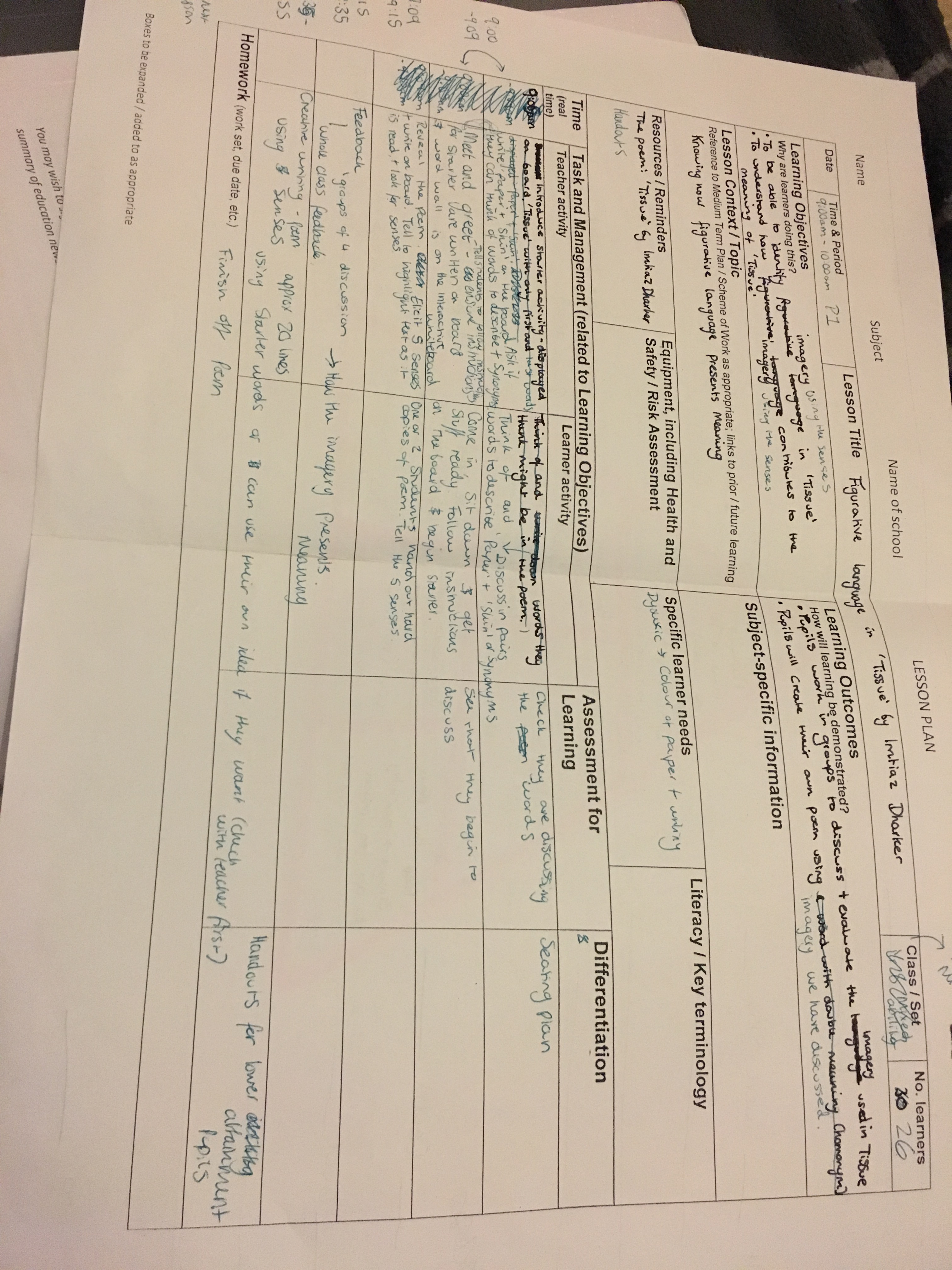
We spent a lot of time in our sub sessions talking about lesson planning, focusing mainly on medium term and specific lesson plans. I am going to focus on the lesson plan I created with my partner, and the turmoils we faced whilst we attempted to perfect the timings and activities.
Our initial idea was to explore figurative language in Tissue. We drew upon ideas, decided to do various activities and then hit a brick wall. How where we going to cover everything in a one hour lesson? After getting a bit of help, we realised that it would be more beneficial to us and the students if we were more specific with what we wanted the learning outcomes to be – in other words keep it simple and specific. So we narrowed it down to imagery. Turns out this is just as vague so eventually we narrowed it down to the senses and then our plan took place!
I’m including a picture of our plan, it is hella messy because we changed it heaps, it is also not 100% finished as we discussed a lot but ran out of time to write it down! However, I am confident that we have refined our plan and it is now a teachable lesson. This was also due to, I believe, finally getting a mock up class list so we had an idea of how we could differentiate the lesson. This made it somewhat easier, but I think it will also be a million times easier (note easier not easy) when I know the children I will be teaching well enough to adapt the lesson for everyone. (I know that probably sounds optimistic but we’ve all got to aim somewhere!)
Class Readers
We also had a look at class readers, the text (generally a play or novel) that a class will read together and follow along at the same pace, usually over a few lessons. We discussed various ways to approach class readers and also talked about the advantages and disadvantages of using them.
We then got the first few chapters of Pigeon English by Stephen Kelman, and were asked to try out a few techniques to read them in a group. I think the resounding thing our group found was that, even as literature lovers, we found we got distracted easily for a range of reasons. The text itself was phenomenal and I have definitely decided to put it on my to read list… so why did we find it so hard?
Reading out loud can be a nerve racking thing, everyone slips up now and again and it is easy to get bored if someone is reading too fast or too slow. For me, the best way we did was the ‘popcorn method’, where the reader can nominate anyone to read and each person only reads as much as they want to. This kept us on our toes and, interestingly, we found ourselves picking on our colleagues that did not appear to be paying attention. Now who knows if this is something the children will do or if this is just the teacher within us all making an appearance!
Inclusion and SEN/D
For our first masters level assignment, we will be following ‘learner x’, a pupil with SEN/D (Special Educational Needs or Disability) and we had the introductory lectures to this task this week.
My favourite of the lectures has to be the one where we had people from a SEND department come in and talk to us, bringing along a few students with additional needs. Hearing the students side of their school life really hit home – I know inclusion is important of course, but knowing the little details that could change the child’s day for the worse only emphasised to me that it is of the upmost importance that I get to know my students as well as I can.
I am actually looking forward to this assignment, and eagerly anticipate next week when I hopefully get to meet my learner x.
Observation Versus Judgement
This will just be a brief note here, mainly to remind myself if I ever forget. Observations are what you actually see, judgement is what I think I see. For example, an observation would be that children have their heads down on their table, a judgement would be that these children are not engaged. Use the observations to back up judgments ad explicitly state what I have seen in my assignments – every judgement needs evidence!
First Impressions
Most excitingly this week we got to meet our personal tutors for our first placement, well I say personal tutor, in my case one of the deputy heads came to greet us due to unforeseen circumstances. It was honestly such a relief to be able to have a little chat before starting next Tuesday, and having a few trivial questions answered.
The school I will be working at has a ‘ready to learn’ behaviour management scheme in place, which is basically a zero tolerance method. I am grateful that all the behaviour management is in place for me to use already, as I feel like that is one less thing I need to worry about when I teach for the first time (scary how this is getting closer and closer!). It is also a Catholic school and I am excited to see how faith is integrated into the English curriculum.
Transferable Techniques
- Working with a collapsed text: Using all the words of a poem (or any other text) put in alphabetical order and ask the students to create a piece of creative writing only using the words provided. Also, using a word wall – where all the words of a poem (or other text) are blanked out and words are revealed one by one (or however you want to do it).
- The ‘popcorn method’ for class readers
J
Currently Reading:
The Penguin Book of First World War Poetry – Edited by George Walter
Back to the world war poetry again, I think I’m gonna alternate each week between this book and the contemporary poetry book. One poem that particularly stood out to me this week is August 1918 (In a French Village) by Maurice Baring. It is a short poem, only having 2 stanzas, but the contrast between the 2 stanzas was what really grabbed my interest. The first is a beautiful description of village life, and this is juxtaposed with distressing imagery of war and death.
The Tempest – William Shakespeare
I have just begun Act 2 of the Tempest, and I am further reminded of the interesting character of Caliban. I can remember having discussions at school whether he was evil or whether he was merely an innocent being that Prospero is abusing. I also can quite confidently say that I have no idea how the play is going to turn out! To be fair to myself, it has been over 10 years since I last studied the play. I am excited to remind myself about the play and to follow the characters into the unknown for the second time in my life. This just goes to show that rereading a text is never a bad idea!
Mrs Dalloway – Virginia Woolf
The more I read this novel the more I fall in love with it. Woolf is quite clearly an ingenious writer, to cover so much detail over a course of a day is astounding! The part I read this week focuses on Mrs Dalloway’s daughter Elizabeth and how she has her own independent mind. Her relationship with Mrs Kilman is a bit confusing, potentially because I have the bad habit of skim reading, or could be that way on purpose! I am still not sure if Mrs Kilman loves her or is jealous of her… or both! I am also waiting for the climax of the novel… I feel as if there is something building and Mrs Dalloway will be the cause of some great distress. Time will only tell if I am way off the mark or not!
Junk – Melvin Burgess
This book was harrowing. The book follows Gemma and Tar as they both run away from home and go live in squats and, not surprisingly due to the title of the book, become heroin addicts. I don’t want to give too much of the plot away, but the changes you see in the characters – particularly Tar – just emphasises how ‘junk’ can destroy someones life. There were moments where I was nearly brought to tears (probably would have been brought to tears if I wasn’t reading it on the bus!) and it really opened my eyes to how important safeguarding is within a school! (Definitely would have had a different reading if I read this as a teen!) If someone at their school noticed that Tar was being abused at home, would he have run away in the first place? How different would their lives have been?
This is definitely a book aimed at an older reader, with themes such as drug addiction, prostitution, abuse, rape, pregnancy and abortions, a heroin addicted baby, homelessness amongst other things found throughout the novel. I would definitely be reluctant to recommend it to students until I knew they were mature enough to handle these deep issues. Nevertheless, it is a fascinating read and I am intrigued to watch the BBC adaption in the near future!
 Much Ado About Teaching