
Introduction
This week I worked in school Tuesday – Thursday, which meant that I have taken place in ‘Curriculum Enrichment day’, where one-year group spends the day in two subject areas, tutor evening and a whole school photo. Interestingly, this whole school photo on happens once every 5 years… just happening to fall on a day that I was at the school. I was also wearing a very subtle blazer… the shade of vivid canary yellow. Great… I will now be the member of staff that no one can remember! We missed a lesson and a quarter due to the photo, something I feel the kids appreciate more at the moment than the photo itself! It also provided me with having to make small talk to a lot of members of staff that I have no idea who they are or what they do… one thing I am forever grateful for is that everyone at the school is genuinely welcoming. I am also feeling relieved at the fact that a lot of the people I have met have graduated from the same university I am studying at… makes the future job prospects seem a little less further away than anticipated!
Assessments
In our university sessions this week, we had been focusing on assessments and looking at progress 8. We had been discussing how useful formative versus summative assessments are, as well as focusing more on what how assessment works at our various placement schools.
It was very interesting to hear about the different ways schools go about marking work. Some schools just give feedback on SPaG, whereas others focus on positive reinforcement – with the majority doing a mixture of both. Some give out grades for every piece of work and others just use comments, as they say the students were focusing too much on the grade and not enough on how to improve themselves. I think that a mixture of everything is healthy – and I also believe marking should be differentiated appropriately. For example, a higher attaining student would benefit from a focus on SPaG, if that is what could potentially bring their marks down, whereas a student with mental health issues may benefit from a lot more positive feedback so that their self-esteem does not go down.
The way the schools are now judged on attainment is, I feel, a lot better than the old system. When I was at school, a student had to get 5 A*-C grades to count. This potentially meant that lower attaining students might not have got all the support they needed, and they may have felt like a failure as schools were pushing students to expect to get a C grade. The way they work it out now is to do with how much progress they individually make. Each student gets a calculated predicted grade for year 11, and ‘progress’ depends on if they meet this grade, which potentially means that the higher attainers in year 6 have a harder time meeting this than a lower attainer. Obviously, the system isn’t perfect, and I feel as if it would be hard to create a perfect system in ‘judging’ schools, as there are a lot more factors in how a student does in their exams than just the school’s input.
Curriculum Enrichment Day
On Wednesday this week, the school I am at had a Curriculum Enrichment Day (CED). This is where each year group spends half the day looking at one subject but doing things a little differently to a normal lesson, sort of like intervention sessions. English had year 9, and we spent the day looking at context for poems they will study for GCSE. It was super fun, most of the students seemed engaged, which was probably down to having a few more video clips to analyse than they would normally have! We also finished with a Kahoot! Quiz… they loved it so much that I have decided to put one in place to do in a revision session for A View from the Bridge.
‘Marco’ Starter Critical Analysis
My criteria for creating a starter for this lesson was to focus on the character of Marco in order to remind the class about him before getting to the ever-important chair scene at the end of act 1.
My first minor mistake was writing the title ‘Marco’ on the board, as the regular teacher asked me what the title of the lesson-was and I eagerly offered to write it out on the whiteboard. I swiftly realised that this then gave away the answer to my bell work question… and I didn’t intend them write anything down until we moved on to the language use… oops! My not so subtle groan and remark to the other teacher about how ‘I gave it away’ now lead to a few laughs in the class so at least I’m building up relationships with the class?
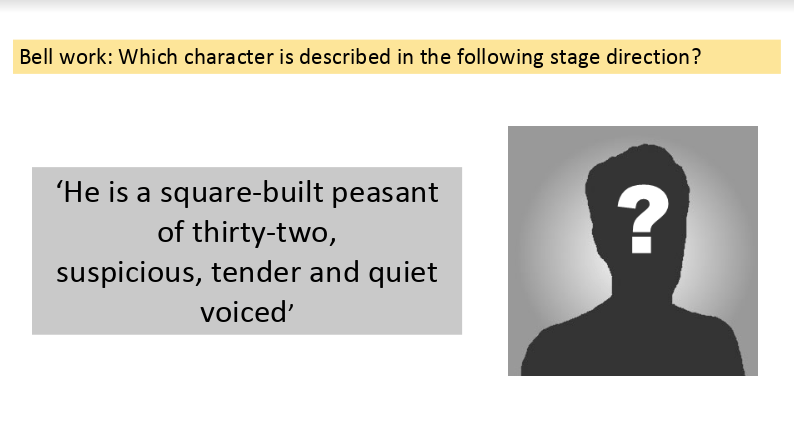 One thing I am going to note here is that my classroom management for this class did not feel very natural and I know that this is down to me only knowing a handful of names. Seating plans, without photos, are only helpful if everyone is sitting exactly where they should be, and this isn’t always necessarily the case. One thing the head of English (HoE) said to me was to ask them to remind me of their name if I am not sure. Side note… I also find a lot of names extremely hard to pronounce, so if parents could start naming their children one syllable regularly pronounced names that would be great!
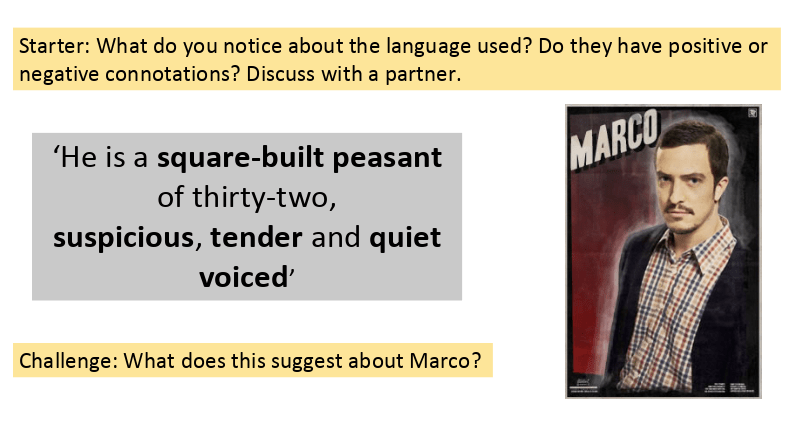
Nevertheless, I strode on with the lesson and, despite muddling my words up every now and again (still working on that… and I imagine it will be something I will be working on for the rest of my life). I introduced the next part, where we were looking at the language used and whether they felt it had positive or negative connotations. I asked them to discuss this with a partner for around 5 minutes, and I went around the classroom ensuring I spoke to a range of different students.
Focusing now on one of the students I talked to, I was particularly proud with the progress she made. She did not engage with the text originally, but when I broke it down for her, asking what the connotations for each individual word have, she came up with a fairly strong analysis of his character. I then asked her to share this with the class and she seemed very proud of herself for being able to share a valid response with the class.
Another student analysed the picture instead of the stage directions, so it made me aware of both being completely clear with my instructions, and also ensuring that the PowerPoint slides are clear – I could potentially have made the image smaller, not used an image at all or even explicitly stated do not use the image.
 In order to provide a better understanding of why Marco and Eddie’s relationship begins to get a bit strained at the end of Act one, I decided to focus on what kind of relationship Marco and Rodolpho had, and where the power lies with the siblings. I had discussed with their usual teacher during their previous discussion to tell them that I will expect silence in this part. I did this, but, as they are sharing the class reader between two, in my opinion it was hard and potentially unfair to enforce silence. In hindsight, I feel like this task should’ve been a discussion and the previous task could’ve been in silence.
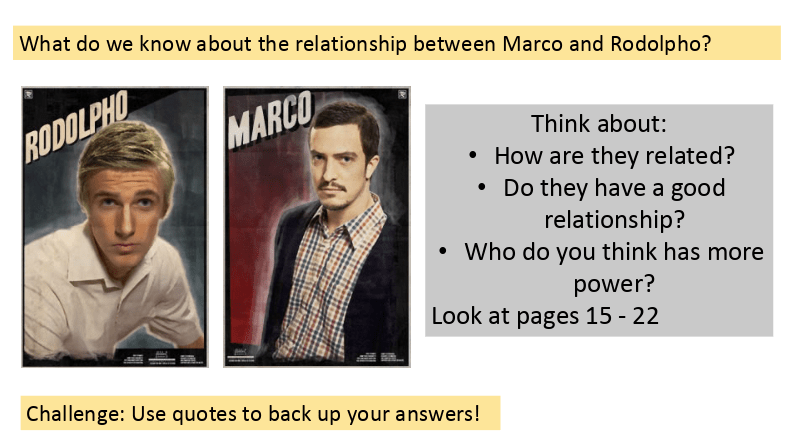 When it came to getting feedback from the group, I used the seating plan to randomly pick on people who hadn’t contributed much so far. This kind of backfired on me, as one of the pupils I asked had quite clearly not been doing the work and could not give me much more than ‘I don’t know’. I said to him to have a quick look now and then I will come back to him later. Firstly, I forgot his name when I went to get back round to him, and then he was still adamant that he did not have anything to contribute. I was not sure how far to push him, but I also did not want to lose their respect so early on in teaching them, so I went over to him and pointed to a stage direction that would help him. He eventually gave the class an answer, even if it was not particularly well thought out.
It was around this time that the class started to lose concentration, and one of the things the teacher observing me said was to make sure I wait for silence, use my language and my body language to be clear about what I expect in the classroom.
Ultimately, I feel as if the students did revise the character of Eddie, and they used that understanding later on in the lesson when they read the play. Despite a few classroom management issues, I feel that this went ok for my second time.
Drop Everything and Read
I’m not sure if I have mentioned this before, but drop everything and read is where the students spend 20 minutes silently reading, regardless on the lesson they are in. I absolutely love this idea. Reading is something that generally is only done in English lessons and, despite being asked to spend at least an hour a week outside of school reading for pleasure, this is not something every student does – or even has the ability to do.
Tutor Evening
This week I stayed behind to see how tutor evening works. The class I am with for tutor time is also one of the classes I will be teaching in English, so I felt it was extremely useful to learn a bit more about each child that came. I was only going to stay for an hour, but I ended up staying for the whole time as English came up as an issue with a few of the students. I feel like the more I get to know the students, the better equipped I will be able to teach them. It was also good to be able to spend some time at the school in a less formal setting. They have subject evening next term, and I will be interested to attend that to see the difference!
Transferable Techniques
- Kahoot! – Being mindful of the fact that the kids have a great time choosing their names (trying not to laugh at some of the more inappropriate names is going to be a challenge for me!)
Teaching Targets
Last week’s targets:
- Teach at least 2 more starters next week.
Target complete! Well, I only actually taught two more starters, but that was mainly down to being off timetable Wednesday.
- Ensure I am confident in all aspects I will be teaching before I begin to teach.
Before taking the two starters, I ensured I read through the content thoroughly the night before, even reading the out loud to myself to make sure I don’t jumble my words up too much (my cousin must think I’m mad when she hears me!). However, I am 100% sure that I did not complete this target. I feel this is mainly due to making it a bit too broad, thus being unachievable in my second week (something I fully intended not to do!). There is no way I am going to be confident in all aspects of what I am teaching at this stage. There is far too much going on in the classroom and I have learned my lesson this week to concentrate on just a few things at a time, which I am going to choose for next week’s targets.
Next week’s targets:
- Scripting ‘teacher talk’ so I know what I will be saying when, and also scripting ‘student talk’ so I have a clear idea of what I want the students to be saying to me, so I know they have learned something.
- A focus on minor behavioural issues: Remember to use the Ready to Learn system already in place, and also ensure that the students are silent when I speak as well as before I start speaking.
- Learn all the names of the students I will be teaching. Slightly ambitious, I know. But, as stated earlier, class management felt 100% easier and more natural with the year 7s, as I am fairly confident I know all of their names now. I am in school all week next week and honestly, I this is the only thing I achieve next week I believe I will thank myself a lot for it! (Let’s just hope I don’t forget them all again over the half term!)
J
Currently Reading:
Contemporary Poetry: Poets and Poetry since 1990 – Ian Brinton
Still ploughing through the theory… kinda just want to get on to the poetry now.
The Point – Kate Tempest
I don’t know what it is about poetry, but the more I analyse it the more I grow to love it, and this is definitely the case with this poem. I looked at it briefly last week, with the intentions of taking half the lesson and, in preparation for playing it in the lesson, I listened to Kate performing the poem. Listening to poetry poignantly read out always provokes an emotional response to me, but the more I listened and reread it, the more its beauty stood out to me.
The Tempest – William Shakespeare
I don’t know if I’m the only one who does this, but to appreciate Shakespeare plays fully I need to read them aloud and give voices to each of the characters (another way for my cousin to find me slightly insane). I have whizzed through acts 2 and 3 now, and I have to say my favourite parts are still with Caliban! The scene in which Ariel winds up Caliban, Stefano and Trinculo is absolutely hilarious, and the fact that Caliban keeps insulting Prospero and treating Stefano like a King is equally funny. I am thoroughly enjoying rereading this play!
A View from the Bridge – Arthur Miller
I am going to have to add this to my list at the moment, seeing as we are reading it in the year 9 class I am team teaching in. We are just at the end of Act 1, and I reread the closing scene of the act whilst preparing for the lesson starter I designed. The power struggle in that scene provides gripping entertainment. The more I read this play the more I completely fall in love with it!
Demon Dentist – David Walliams
I read just over a third of the book in the half an hour I designated towards teen fiction this week, and I have to say it is a blessing to my overworked brain to be able to zone out and just read something ridiculous! I can totally see why this novel would be popular with the young people. It plays on the idea of a fear of dentists by creating a hyperbolised evil character that has all sorts of gruesome ways to ensure the children go to the dentist. I also appreciate the fact that Walliams has made the protagonist’s father a single Dad in a wheelchair, and a social worker is called in to help them. I always find it refreshing to see children’s authors taking a step away from the nuclear family – something I know authors like Jaqueline Wilson have always made an attempt to do.
 Much Ado About Teaching