Week 22 – The Epiphany

Introduction

This week, I had an epiphany. This epiphany was that I can teach. I am a teacher. 

No matter what happens next, with review point 2 and my PT observing me next week, I can sleep soundly knowing that when my students come into the lesson, they will leave it having learned something (the vast majority of the time!).

This epiphany has been a milestone in my PGCE career. I am no longer stressing about every little target and are looking at them as the stepping stones to make me the best teacher I can possibly be.

I want to be the best teacher I can possibly be. 

So, with that in mind, I am as determined as ever to continue what I am doing, but to also let myself appreciate other things that are important in life. It was one of my friend’s birthdays this week, so I have allowed myself to have two evenings off (crazy I know) and dedicate my time to her. Yes, the work load is never ending. Yes, sometimes I feel like I’m drowning in things I need to get done. Yes, the stress that I am not working when I feel like I should be working 24/7 is never going to go away. BUT, I have been working on focusing on what I need to do to keep myself sane. Regardless of these epiphanies, I’ve been feeling more down than up this week and I can’t seem to pinpoint why. This next step in building my career is to make sure that it is manageable for me, and I don’t isolate myself in an infinite prison of work. I can be a good teacher and maintain good mental health – it’s just going to take a bit of time to work out how to harmonise the details.

Bottom set year 10, period 5, teaching tissue – so why the LOG?

Picture this….

‘Tissue’ by Imtiaz Dharker. Stunning, thought-provoking and inspirational, yet completely, utterly and astoundingly difficult to grasp. I have spoken to some teachers who still say they have no idea what Dharker was trying to achieve with this poem. Every English teacher I have spoken to has said this is, generally, the hardest poem to teach; the hardest poem for students to get their head around.

Tuesday, period 5. The end of the day, just had a break for lunch, concentration levels are low. The week is still new, there is more left of the week than done. 

Year 10. Bottom set. Concentration levels aren’t best on the whole, throw something challenging in the mix and they don’t always appreciate it. 

So why, why WHY did I decide to make this an officially observed lesson by my AT? He doesn’t know the class, but is obviously familiar with the lesson context, mentioned previously. (This was definitely a blessing in hindsight.) I was stressed beyond imagination about this lesson. One of my lovely colleagues said to me something along the lines of if you nail it, you’re a fantastic teacher. If you mess it up, you’re just like the rest of us – this made it feel more manageable but didn’t stop my nerves. Did I mention that I had already started Tissue the day before, it didn’t go overly that well and this is why it was moved to this lesson?

However, despite the over the top anxiety, the lesson couldn’t have gone better! (Actually, it definitely could have for reasons I will explain in due course… but in comparison to my expectations, it was the best it could’ve been!) The students were actually able to prove they understood (on a basic level) the poem and seemed to make progress in how they structure and write their ‘PEAL’ paragraphs (I mean we’ll see if they remember everything for the end of unit assessment, which will most likely be after half term!) 

I also managed to tick off one of my targets – adapting the lesson as I go to meet the needs of pupils. I had a little… moment of human error. I may have been too prepared for the lesson, printing off the resources before checking them properly. I had typed up the paragraph we wrote together the lesson before, with the intention to have them underline where we would have met the assessment objectives. I then had another model paragraph ready, cut up so they could piece it back together. Turns out I had used the same paragraph for both activities, making the latter redundant… not my smartest move! However, I felt it was important to be completely honest with my students. They are all aware that I am a trainee teacher, and I feel that they empathise with me and – dare I say it – like me more because of my honesty with them. By treating them with the respect, on the whole, they have been completely respectful to me back. I like the idea that by showing them that I make mistakes, it makes it ok for them to make mistakes too – and that’s important.

After the lesson, I felt elated and relieved. However, the stress has come right back around again…. My PT is observing me with this class again on Tuesday. She is a deputy head, so hopefully they will behave… they definitely had ‘wind syndrome’ today, so I wouldn’t want a repeat of that!

Impostor syndrome strikes again

One of the things that I can’t seem to stop thinking about is how other teachers feel about my teaching. Every teacher seems to have their own personal list about what makes a good lesson, and they only seem to vaguely overlap with main ideas. This leads to me getting very varied feedback and can be completely confusing at times. 

The one thing I find particularly hard to deal with, is when teacher’s interrupt my teaching to make a comment to the class. I know it is meant with the best intentions, and I am also completely aware that this is their class, and they are ultimately responsible for their progress – I am a complete risk in the eyes of education. 

One moment that has particularly stuck with me this week, was when I was doing a preparation for the end of unit assessment. They were due to plan their assessment with their class teacher on Wednesday, as my PT meetings clash with that lesson, and she has taught travel writing many times before, and has a really clear idea about what she expects. Now, I knew that the students were going to write a piece of travel writing to entertain. We had looked at writing to inform and to persuade as well, and as a result used their ‘FASTER CARS’ acronym for what to include in persuasive writing. 

I was taking general feedback about what makes good travel writing. I have been working on how to give students ownership over success criteria and, after spending a lot of time having to shut students down because it isn’t what I want them to come up with, I have found the easiest way to do this is to write down everyone’s answers and then come up with a final list. One of my higher ability students suggested FASTER CARS, and I added it to the board. In my head, I thought ‘great, a lovely little afl piece I can use later, asking them why we wouldn’t include this if we were writing to entertain’. Whilst I was writing this on the board, the class teacher addressed the class, completely shutting down the idea and explaining why that wasn’t going to be the case.

I know exactly why she did it, it just felt awful at the time. I felt completely undermined, more so because she didn’t give me a chance to see what I might’ve done with that information, or even catch my eye to see if it was ok to address the class. Moments like this throw my confidence and make me feel like just a trainee. I know it might sound silly because that is, in fact, what I am. But the majority of the time, as mentioned in my introduction, I do feel like a teacher. It’s just those moments that make me question my role in the classroom. Why am I doing this? Why am I humiliating myself?

Finishing travel writing….

On a slightly better note, I swiftly moved on from that moment and the students wrote their assessments on Thursday. They worked so hard! I have started marking them, based on the English Language Paper 1 Q5 mark scheme and grade boundaries and, so far, everyone has been on or above their target grade!  It is such an amazing feeling! 

… and starting 19thCentury Prose round 2

So, after finishing travel writing, which has definitely been my favourite SOW to teach, it was time to move on to 19thcentury prose. I recycled the introduction lesson, playing the Dickens’ game and research. It was a complete dream planning the second time round – I already had an idea of how to improve my planning, resources and teaching. 

This was the sheet I used last time, for the research project:

They also had to find 10 more fascinating facts for homework and print out any pictures they want to use on their posters.
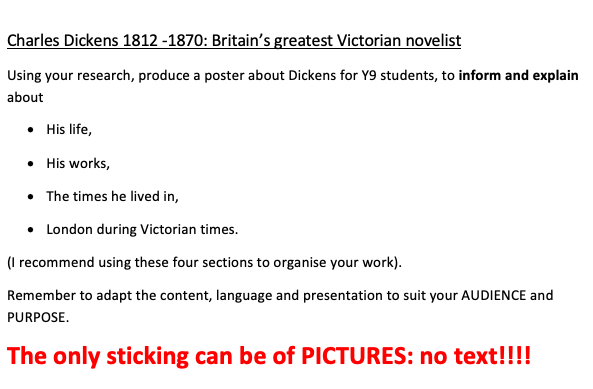
I found that some of this research was not directly relevant to the texts we study, and that it could be more useful to focus on gender and class, as opposed to London. Moreover, I had them take a page in their books and draw their own grid, with the intentions of having it filled in by the end of the lesson. I found that a lot of students spent nearly as long drawing and perfecting the grid than they did actually researching, and that a lot of them didn’t get at least 5 facts in each section – which was my minimum aim.

This is the new resource I created:
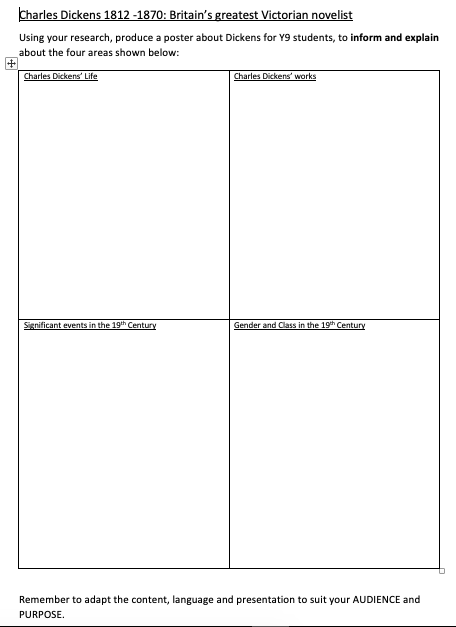
I figured that if they had a print out of the sheet, they would be able to take it home to finish off for homework (a fantastic motivating factor!). I also added to this homework, by telling them to find 5 fascinating facts about Bleak House. I am hoping that this will help them to have an idea about what the mammoth novel is about, before approaching it with them next week.

My hard work paid off – this was definitely an easier way to do the research! I also asked them to pair up and split the research, as we didn’t have as much time as I would’ve liked (Friday timings are slightly shorter and I was in a year 10 assembly that ran on for an extra 5 minutes = 10 minutes of lesson time gone… plus we had to actually get to the computer room!). The majority got at least 15 points down, and they worked well together to finish off their research… although they will be dismayed when they see I have put them in different groups on Monday! 

J

Currently Reading:

The Eolian Harp & Kubla Khan – Samuel Taylor Coleridge

Kubla Khan is now one of my favourite poems. It is a unique poem, interweaving the ‘sublime’ with the exotic, creating a beautiful Romantic masterpiece. 

Bleak House – Charles Dickens

Animal Farm – George Orwell

A Monster Calls –Patrick Ness

More than one tear was shed in the reading of this book – cancer being an illness very close to my heart. I loved reading about a boy struggling with accepting his Mum’s inevitable death. A very accessible book, an easy read but a sensitive topic… may not be suitable for all students!
Week 14 – Placement 2 Preparations

Introduction

Back at university again this week, although it has been lovely to see all my colleagues, I can’t help but miss being in school… that’s why I’m doing the course after all! However, despite feeling completely exhausted and pretty unwell, I have enjoyed some of the things we have been doing.

Reflecting on Placement 1

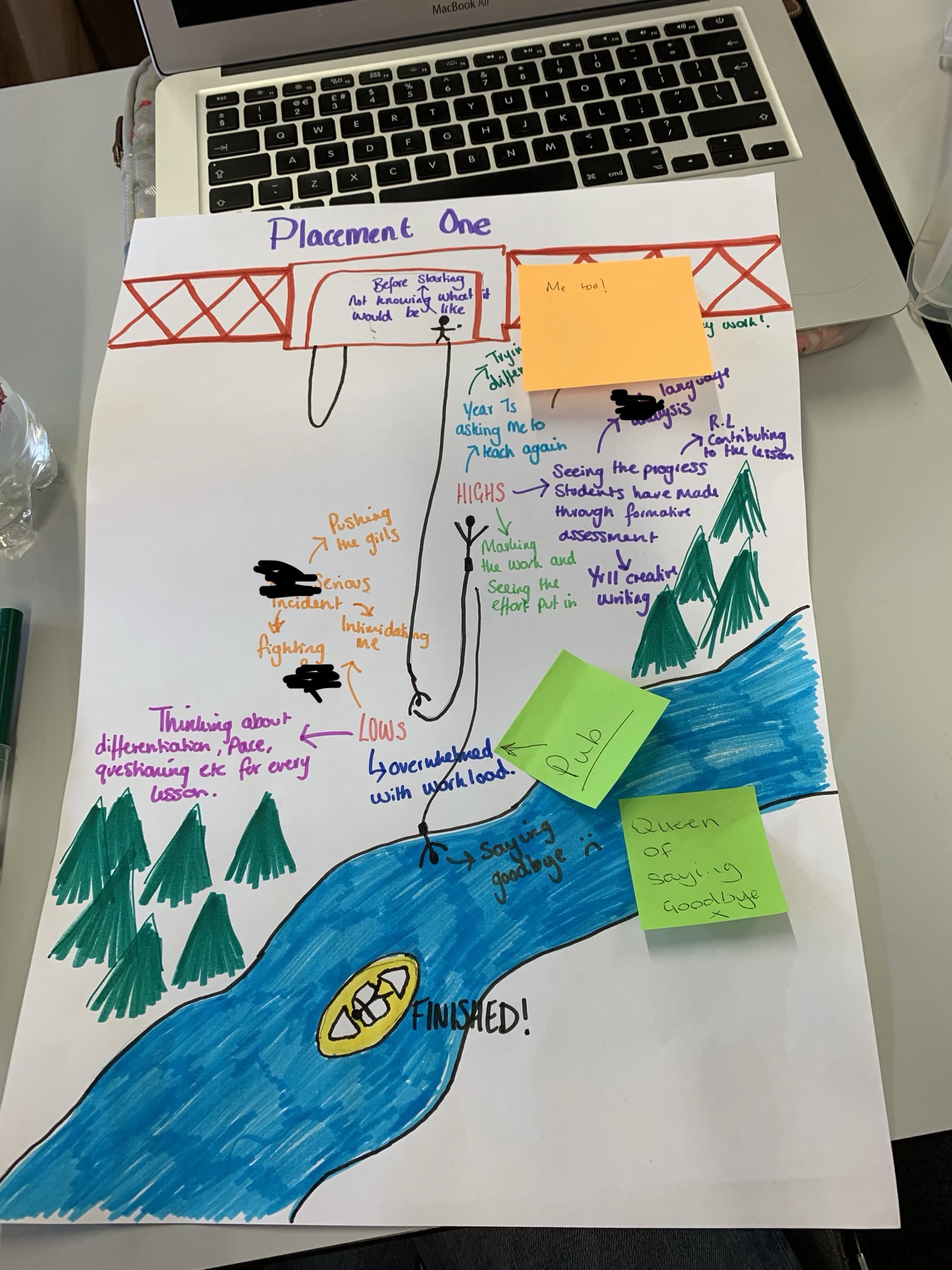
As anticipated, everyone was full of anecdotes from their first placements and we spent a fair bit of time reflecting on our placements using a visual metaphor. I opted for a bungy jump, focusing on the nerves before the placement, the lows, the highs and saying goodbye. I didn’t quite get a chance to finish it, colouring in takes a long time! Yet, I got the main points down before we got a chance to go around and see the metaphors everyone else had created, commenting using post its. It was a lovely way to bring our first placement to a close before we found out where we would be placed for the long placement. 

Visual Metaphor of Placement One

Mental Health in Schools 

As part of the EPS lectures this week, we had a session on mental health in young people and how we can build strategies to help support our students. This was fascinating for me, particularly as, when I was at school, there were many of my peers struggling with their mental health – including myself – and it never got picked up on by anyone. I struggled by myself for a long time and I know now, after sharing with some of my friends, I was not alone in my feelings. However, when I was at school mental health was nor normalised and actually, I didn’t know that what I was feeling was an illness. 

There are many things, such as academic stress, bereavement or bullying amongst others, that can trigger poor mental health. Teachers, due to the amount of time they spend with students, may be the people who pick up on these things, thus have a responsibility to help a struggling young person.

 Personally, I feel as if all of this was very similar to the safeguarding lecturers – if I have doubts about any of my students, I will voice these doubts to the appropriate people. However, what I have taken from this lecture is that I need to model appropriate behaviour to my students and I also need to ensure my classroom is a safe space, talking about mental health (particularly in tutor time) to normalise it.

A-Level English Language

We were lucky enough to have an expert in A-level English language come to speak to us this week and it brought back all the amazing memories I have from taking the course myself way back when.  We were looking at word classes and linguistic terminology – including a bit on phonetics – and I wish I had been feeling well enough to completely engage in the task. I love this stuff! It also reminded me to send my uni notes to my cousin… something I have been promising since September! 

The Science of Learning 2

Following on from his previous lecture about engage-build-consolidate, we had the professor in to give us a specific seminar in how we can relate that to our subject – more specifically the use of creativity.

In a nutshell, different environments can help to stimulate different responses to learning. For example, generally one may expect to find a learning environment that increases focus, offers rewards and has an element of mild stress, potentially through anticipating assessment. However, when doing creative tasks, it is actually more beneficial to have a disruptive or broader focus, less stress and only use evaluation after generating ideas. This is in an attempt to move away from the automaticity usually expected for students to consolidate their knowledge, thus being able to apply this knowledge in different ways (moving up blooms taxonomy). 

It’s been a while since I did anything remotely scientific, so at first these lectures appear a little intimidating, but actually this approach makes a lot of sense and will hopefully help me plan lessons in a more useful way!

2 More Assignments

People who say the PGCE year is intense and stressful weren’t kidding – the workload is ridiculously high, and I constantly have waves of imposter syndrome and feeling completely overwhelmed. Every colleague I spoke to this week feels pretty much exactly the same, so I am so glad that we are in this together, providing support when we all need it. Such a lush cohort! 

On Monday we submitted the assignment on SEND, I finished this last Friday and relished in having a completely free weekend. By Thursday we had another two assignments left and I was kinda wishing I could Groundhog Day last Saturday. Nevertheless, I am actually looking forward to doing both assignments.

The EPS assignment is a research-based task, and we can pretty much choose to research whatever we want, as long as it relates to one of the teacher standards. My two ideas are:

  • Looking at something to do with looked after children (LAC) and ready to learn/ behaviour management techniques (influenced by my last placement!)
  • Looking at something to do with gifted and talented sixth form students

I honestly don’t know which one I would rather do! I spoke to my new PT about this on Friday; she says I will definitely be able to do the second but will need to look into whether there are enough LAC in the school.

The subject assignment is to design your own scheme of work, basing it within selected pedagogy, teaching and reflecting on it. After speaking to my AT, and class teacher, I think I will be doing Animal Farm with the bottom set year 10s. Should be interesting to do from a differentiation perspective! 

Placement 2 Induction

I met my PT for P2 on Thursday afternoon, and she seems completely lovely and so supportive (I have heard lots of good things from my colleague who went there for P1). It is a very different school to P1, which I am excited about as it will hopefully give me a completely different teaching assistant. On paper, it sounds a lot like my own school experience – I am most excited about getting sixth form classes! 

With regards to what I will be teaching, I have already got a provisional timetable and will have 4 sixth form lessons to teach as well – to be confirmed by January. The classes I will definitely be taking are:

10C2 – Tutor group: not teaching this group this time, hopefully I will build up just as good a rapport as I did with my year 8s in P1!

10×5 – Looking at the power and conflict poetry anthology before half term, animal farm afterwards. A bottom set which will be interesting after coming from all mixed ability!

9×5 – Travel writing before half term, 19thCentury literature afterwards.

9Y5 – 19thCentury literature before half term, travel writing afterwards.

6thform classes to be confirmed.

I am particularly excited to be having two year 9 classes (side note: I observed a lesson with 9X5 today and they are lush, got into a full-blown conversation with a couple of girls about harry potter and the hunger games… I love them already!), my AT gave me the choice of teaching the same thing side by side or doing two different units. I opted to go for two different units, as I know I will learn a lot in teaching each SOW and will be able to put these reflections into good use when teaching the SOW again! I’m excited to have the chance to actually redo the lessons how I see fit, taken on board observation notes.

I am not gonna lie, I am completely nervous to be starting at a new school, even after going in for a day. Everyone seems so lovely and it seems like such a lush school – the kids appear to be beautifully behaved the majority of the time! It’s crazy to think that I have only had a week’s break from teaching – I already feel like I am not sure what I am doing: it’s like the bungy jumping metaphor, no matter how many times I go to start again I will always feel like I am standing at the top of that bridge waiting to jump. Hopefully all will be well – I have already agreed to teach both year 9s from the first day back… jumping in at the deep end worked last time so I am praying it will work again!

Transferable Techniques

  • Getting A-level English Language students to go through the mark scheme with three different coloured highlighters for nouns, verbs and adjectives. Looking through the bands to see what is expected for each level.

J

Currently Reading:

The Importance of Being Earnest – Oscar Wilde

I seem to have misplaced this play…. reading will be on hold until I find it annoyingly!

The Remains of the Day – Kazuo Ishguro

Still (slowly) ploughing my way through this novel, don’t hate it and don’t love it, not really much else to say on it at this point in time!

Ketchup Clouds- Annabel Pitcher

I love this book! It is about a young girl writing to a murderer on death row, talking about the boy she says she murdered. It is an epistolary novel; written in letters. The form works beautifully for the story line and each letter slowly reveals a new twist in the plot – I am dying to find out who she killed and what happened, and even if it is even her fault.

Over the next few weeks I am going to prioritise reading what I will be teaching, but I will still aim to read for pleasure alongside it! I am determined that the degree will not impact my reading levels, obviously unless I have too much work to do (like last week). I have also been recommended Mortal Engines by one of my year 9s, so I have promptly ordered that and looking forward to reading that after Ketchup Clouds!

Week 10 – Overwhelmed

Introduction

So, this week has been significantly more intense than last week. I have classically gone and done what I always do; agree to take too much on. At the beginning of the week, I agreed to go and talk to the Ofsted inspectors for university, which not only but a halt on my planning time, but also meant I had to rearrange my PT meeting this week. On top of this, I had my university tutor come to observe me on Tuesday afternoon and, despite her being so lovely, I found myself getting unnecessarily nervous for this. So, let’s just say the stress was ramped up a level and I ended up breaking down a bit on Wednesday. However, my lessons on Thursday and Friday proved to be a million times better and I have started the weekend with a new instilled confidence in myself.


Ofsted Round 2

Not long after getting an email, about Ofsted coming to carry out the second half of the university’s inspection, the course leaders sent another email around asking for volunteers to come and speak to the lead inspector. As I had a free in period 5, I offered to come into university, which meant that I sacrificed my planning time, to speak to Ofsted.

Obviously, I am not sure what the outcome is, but the inspector seemed very happy with what we were telling him about the course… fingers crossed to stay outstanding!


University Tutor Visit

As previously mentioned, I was a complete nervous wreck thinking about the university tutor’s visit; I didn’t know what to expect and had no idea how the class would react to my lesson – after the supply teacher incident, my confidence was knocked with this class.

My lesson was the third lesson on Shakespeare sonnets; we focused on the meaning of sonnet 18 and began to compare it to the beginning of sonnet 130. I managed to ensure that every child had contributed verbally, at least once, during the lesson, thanks to my handy ‘good names’ list on the board. I have to say; a lot of credit goes to my gorgeous year 7s… they worked so diligently and had some fantastic comments – I am continuously and regularly very proud to be teaching them!

It didn’t take long for the nerves to wear off to be fair, I got into the swing of the lesson pretty quickly and my confidence grows every time I teach something, and they prove to me in the plenary they have understood it.

I had a meeting with my UT and AT after this lesson and they both had super nice things to say. We worked through my targets for the rest of placement one and my UT noted that, if I gather enough evidence, it seems as if I am teaching at a ‘very good’ standard; for those of you not familiar with PGCE talk, this is the highest you can be. It’s safe to say that I was elated and extremely proud of myself – all the hard work looks like it is going to pay off!

I am going to leave this section with a part of the email that my UT sent me, as a follow up to the visit:

‘Joanne, you should be really proud of the lesson that you taught. You have a calm and confident teaching persona and it is clear to see that you have already established a lovely rapport with your learners: well done. You used a range of questioning techniques to ensure that all learners were involved in the lesson and made progress, and you demonstrated some live modelling with the visualiser.’


Debate Mate

One of the English teachers runs the ‘Debate Mate’ club after school on Wednesdays and, as I didn’t have a PT meeting this week, I came along to help out. Debate Mate is basically a club to help students with their debating skills and they also have an opportunity to compete in national competitions. (Click here to watch the 2018/19 launch video).

I only teach one of the students who attended, but it was super nice to be able to meet a variety of different students. It also amazes me at how much talent lies within the midst of the student body. The students that spoke, spoke eloquently and with such passion and confidence… at the ages of 11-14!


Midweek Breakdown

You would think that after all this great news at the beginning of the week I would be feeling elated and confident in my role as a teacher, that is what any normal human should feel after such fantastic news. Tuesday evening, I definitely felt that way! But for some reason come Wednesday evening I felt my panic and stress levels begin to rise and I just felt utterly overwhelmed and helpless. I negotiated with myself and only checked over my lesson plans for the next day before having an early night.

I’m not going to go into any details, I have no idea as to why this happens to me. It happened the previous week, but I presumed it was a one-off ordeal. It’s starting to become a pattern mid-week, so I am just going to monitor myself and adjust what I am doing accordingly.


Back on Track

Despite this set back Wednesday evening, Thursday proved to be a great day. The only lesson I had to teach was the lovely year 7s…. but, unfortunately, my AT was off again so I was in with a supply! I began to feel the beginnings of panic but held myself together – I knew what I was going to teach (thanks to a kind teacher who talked it through with me in the morning) and I was confident that I knew the lesson well enough, so I only really had to think about behavioural management techniques – that and pray they would be better behaved than last time!

My plan was to give them between 20-30 minutes to finish off their poetry comparisons (I’ve started marking these and some of them have blown me away – there aren’t many adults I know that can write this eloquently about Shakespeare, let alone an 11/12-year-old!), and then we were going to move onto their spacing task for this fortnight – viewpoint writing. The spacing task was to get them to agree or disagree with the statement: ‘Parents today are over-protective. Children should be allowed to take part in risky experiences to prepare them for later life.’

Yet again, I have to give credit to the year 7s. They now completely see me as their teacher – it is just the sweetest thing. I felt fully in control all lesson and, despite a few of them getting excited about the spacing task (one kid was adamant that if you went to the park without an adult you were extremely likely to get kidnapped, another asked what would happen to you if you got kidnapped) – I managed to keep them all on task appropriately so I’m calling that a win!


Progress with a Student

One of the biggest achievements for me this week is making progress with one of my more difficult students in year 9. I can’t remember if I have written about this before, so I’ll just do a quick background: one of my year 9 students has a lot of additional needs, which has related to him being off task and disruptive in lessons. I’m not going to give any details, but there are considerable reasons behind this that I am aware of and I have agreed with the normal teacher that she will help me with him. He very rarely does anything more than write the date in his lessons.

Due to him being in Ready to Learn or being excluded, he has only been in the class twice before, and I have only taught part of one of these lessons.

In fact, it is very rare to have the whole class in – more often than not there has been at least 6/31 off for various reasons.

The first full lesson I taught them… there were only 2 off and I had to adjust the seating plan accordingly. On the whole, my behaviour management was not great in that lesson, but I am going to focus on the positive in this section.

I managed to get him to verbally tell me which introduction was better and why; he responded accurately giving valid reasons behind his opinion. He took himself off to refocus during the lesson but, for me, the biggest win was getting him to stand behind a chair at the end of the lesson. It was period 5, so obviously they are all keen to leave, but I have been insisting on silence and order at the end of the lesson to maintain control of the class. He rushed to the door just as the bell went and I calmly asked him stand behind his chair. After reminding him to do this a few times, also informing him that I too would like to leave, we compromised with him standing behind the closest chair. At the end of the following lesson, I got him to stand behind his own seat.

This might not sound like very much, but I did not think I would even get to talk to me in a respective manner, let alone get him to follow my instructions and even begun to do some work. In just a week I have gotten so far with him, thanks to the teacher working with me acting as teaching assistant as well. I am hoping to see more progress, hopefully he will get to the stage where he participates in a lesson without causing too much disruption, even if he doesn’t do it whilst I am teaching them. It’s the smallest steps that feel like the biggest in learning to teach.


EPS SEND Assignment Feedback

On a final note, we got our feedback on the first part of our SEND investigations and I am thrilled to say that not only was my feedback good, but it was also extremely helpful. I have never had such specific feedback that I completely understand and agree with before. I’m not going to look at my assignment until next weekend, but I am glad that my mind is at ease with regards to this.


Teaching Targets

Last Week’s Targets:

  • Examples & subject knowledge: Subject knowledge is going to be one of those I will be constantly improving, so I am going to remove it from my weekly targets – I am aware I am going to have to adapt and learn as I go, especially as I move from school to school over the PGCE year. With regards to the examples, I am becoming more confident and finding that planning my examples into my lesson plans really helps me – even if I end up not using them and eliciting a model from the students.
  • Questioning: I have been attempting to use think time, something that is definitely a lot easier in theory than in practice, but I have come to the realisation that before I can even think about attempting some of the more advanced teaching skills, I need to work on my basic questioning skills.


This Week’s Targets:

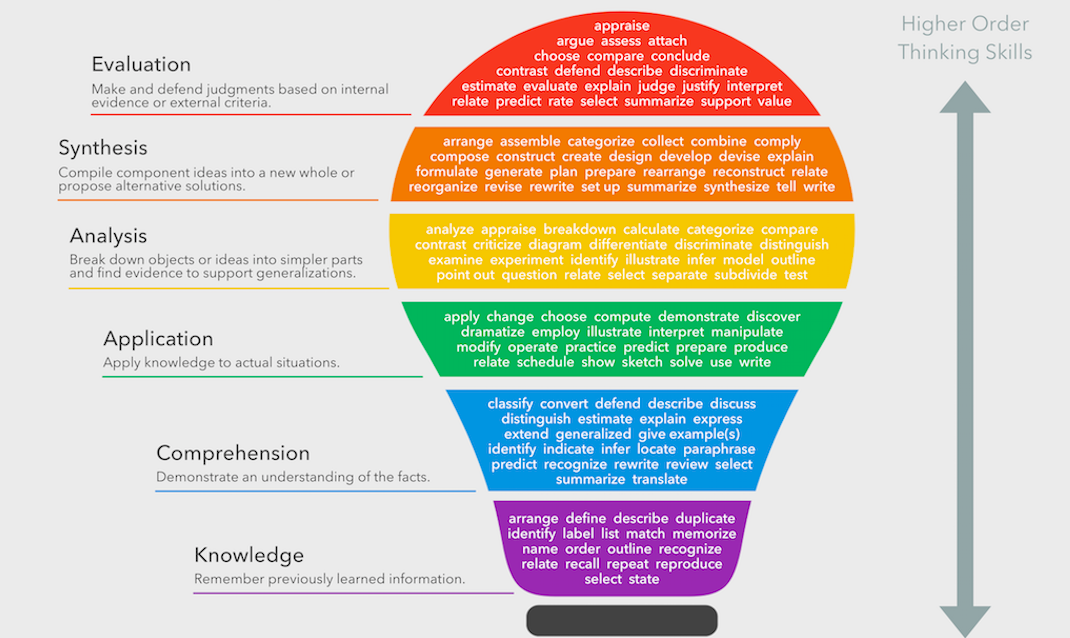
  • Questioning: Building on what I have previously said, I have noted to adapt my questioning techniques depending on what I know about the learner I am questioning: ability levels, any SEND or any prior knowledge. To do this, I am going to attempt to use Bloom’s Taxonomy, something I am going to have to read into a bit more before I can make effective use of it. My university tutor suggested I laminated seating plans so I could write next to the student what kind of question I should be asking them: to monitor who is contributing to the lesson and to what level their answers will be. I am going to attempt to include this into my planning – hopefully it will be effective!
  • Assessment for learning: another target that has cropped up this week, is that I have been neglecting to use assessment for learning techniques to gauge if learners know what they are supposed to be doing; particularly when I give input or set an extended piece of writing. On Friday, I used a few techniques (thumbs up/middle/down; temperature check; common problems) to assess this, and already I am seeing a difference in how well the students are understanding my instructions. As noted in some of my earlier blogs, one of my biggest concerns is that I am not clear enough in how I speak to the pupils, thereby I am wasting my time and their time by having to consistently reword my instructions because I wasn’t clear enough the first time.
Bloom’s Taxonomy

J

Currently Reading:

The Penguin Book of First World War Poetry

Reading first world war poetry on Remembrance Sunday – the centenary of the end of WWI no less – made the readings ever so more poignant. Poetry is one of those beautiful forms where the poet can express a multitude of emotions in written word – often, in my opinion, much more effectively than prose. I find that poetry is not the same read inside my head, so I often read poetry aloud to myself, in doing this last Sunday it made me realise how important this poetry is in remembering those who have gone.

The last surviving English veteran of WW1 died in 2009; in keeping the heightened, harrowing images of ‘the war to end all wars’ alive through various creative means, we are able to remember and be thankful to all of those who fought for us to live the lives we live today, also, hopefully, serving as a reminder to what we should never have to live through as a species again.

The Importance of Being Earnest – Oscar Wilde

So far so good! I’ve not read much but I am looking forward to reading some more this week!

Mrs Dalloway – Virginia Woolf

I have finally finished this novel and I reluctantly say that I did not particularly enjoy this novel. However, I can totally appreciate why people do love Woolf’s writing, the description is detailed and eloquent and her characterisation is phenomenal – I just did not overly enjoy the story.

Dark Woods – Steve Voake

The main gist of the story is that two children go off exploring in the woods near their campsite and a man finds them and drugs them, bringing them up to his cabin deep within the mountain forest. He then shows them that he can bring dreams alive; all he wants them to do is go into his dreams and bring his dog back to life. But there is a twist: he has brought Cal’s nightmare to a reality, and the kids set it free to torment them as they try to escape.

This is a novel that you really have to suspend your disbelief for and I find, when reading children’s and young adult novels, that I read them slightly differently to how I would read other novels; I imagine what my childhood self would’ve thought about them. Bringing myself back to opening up my imagination in any way possible, I am finding I am actually really enjoying this book. It is a simple horror for young people and holds the same gripping nature I would find in that of a Stephen King novel, only made accessible for the younger generation.

Exiting Nirvana: A Daughter’s Life with Autism – Clara Claiborne Park

The chapter I read this week was about her daughter’s experience with language – how long it took her to be able to communicate her unique way of seeing the world. The more I read into autism, the more I feel as if we are extremely fortunate to have these individuals in the world; different perspectives bring layers of meaning to an otherwise mundane world.